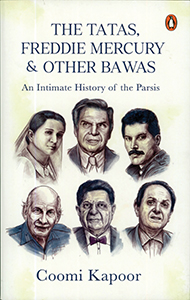
The Tatas, Freddie Mercury and Other Bawas: An Intimate History of the Parsis by Coomi Kapoor. Published in 2023 by Penguin Random House India Pvt Ltd, 4th Floor, Capital Tower 1, M. G. Rd, Gurgaon, 122002; website: www.penguin.co.in. Pp: xli + 334. Price: Rs 599.
It is not often that a book gets reviewed twice in the same magazine by the same person, but the revised edition of Coomi Kapoor’s The Tatas, Freddie Mercury and Other Bawas: An Intimate History of the Parsis justifies revisiting the book. Described as an intimate history of the Parsis, Kapoor’s book attempts to tell the story of the community by shining a spotlight on its prominent members down the centuries. The cast of characters in her book is both wide and varied, from businessmen, lawyers, doctors, academicians, to politicians and cultural icons.

In the second edition Kapoor has added a chapter titled "Pioneers in Cricket, Theatre and Cinema.” Ardesher Patel founded the Parsee Cricket Club in 1876 and also took a Parsi team to England. When the first English team toured India, the captain of the Parsi team was J. M. Framjee Patel who also wrote the classic, Stray Thoughts on Indian Cricket. Contrary to all expectations and predictions, the Parsees won the match. Some unsporting Englishmen blamed the defeat on the lavish lunch arranged by Jamsetji Tata at his mansion during the game! Tata’s elder son Dorabji, who was a keen cricketer, was responsible for facilitating India’s early participation in the Olympics.
The game became very popular and the fame of the Parsi cricketers spread beyond the British empire. It is said that when Jamsetji met US President Theodore Roosevelt in 1903 the President enquired, "How is Parsi cricket getting on?” The community produced stalwarts like Meherwanji E. Pavri, the best captain in those early days; subsequently the likes of Nari Contractor, Rusi Modi, Polly Umrigar and Farokh Engineer all played for India. Engineer, who played his last match in 1974-75, was the last of the Parsi men to play for his country. In May 2021 Arzan Nagwaswalla, a fast bowler who grew up in Nargol and is now based in Valsad, was selected as one of the four standbys of the Test squad for the Test championship final in May 2021 and the usage series in England. He, however, did not get his Test cap.
As far as theater goes the first Parsi "natak” was staged by the Parsi Natak Mandali in 1853. In 1875 Kekhusro Kabraji staged Harishchandra, translating Sanskrit into chaste Gujarati, unlike the colloquial Parsi Gujarati which has many corruptions and incorporates words from other languages. The play was a big success. Many years later there was Adi Marzban with his rib-tickling plays. For many years it was de rigueur to attend one of his plays on Navroz day. Kapoor observes, "He set the template for the characterization of a typical Parsi bawa in Bollywood films, a frequent figure of fun for his eccentricities.”
Kapoor tells us that the early Indian cinema industry is actually a direct descendant of Parsi theater. The first Indian film with sound, Alam Ara, was directed by Ardeshir Irani. Among the early entrants to the film world was Jamshed Wadia (JBH) who set up Wadia Movietone in 1931. He liked stunt films and discovered and introduced Mary Ann Evans, better known as "Fearless Nadia” of Hunterwali fame, to the screen. Then there was the redoubtable Sohrab Modi, the grand old man of the film industry. A Parsi Shakespearean play actor with a spellbinding voice, he gravitated to films becoming an outstanding actor, director and producer. He wasn’t the brightest of scholars though. When he asked his principal for advice on what profession to pursue, he was told "With your voice, you should either be an actor or a politician.” Today the best-known actor is Boman Irani whose role in Munna Bhai MBBS brought him national fame. He is also a photographer and scriptwriter who plans to take up direction. Kapoor could also have mentioned rising star Jim Sarbh who played Homi Bhabha in the Sony Liv series Rocket Boys.
The book which is largely a celebration of the material and cultural legacy of the community is a welcome addition to the literature on the Parsis. It is entertaining and informative and the pace never flags. Anecdotes, titbits and unusual details make the book lively and interesting. One can dip into individual chapters with both profit and pleasure: many of the chapters in the book can be read as standalone articles since the book is theme-based and does not follow a linear narrative. All in all, an absorbing account which covers a large canvas, this is a book to buy and keep in one’s library for future reference.
BAKHTIAR DADABHOY
Dadabhoy is a Delhi based bureaucrat and author.