Died: Dr Ketayun Ardeshir Dinshaw, 68, radiation oncologist and former director of the Tata Memorial Centre (TMC), on August 26, 2011 in Bombay following cancer of the gall bladder.
"She made a major difference in the way the Tata Memorial Hospital (TMH) has moved,” commented Dr Rajendra Badwe who succeeded Dinshaw as director of the TMC in 2008. He was speaking at the condolence meeting convened in her honor at the TMH on August 30, 2011 when her seniors, contemporaries and juniors universally referred to her as an "icon.” Among her "phenomenal contributions” to oncology and to the Hospital were her "courageous decisions” whereby she made it mandatory for the TMH staff to be attached to only one hospital, introducing the scientific review and advisory committees as also the hospital ethics committee, starting a research body, giving impetus to low cost technology like the one at Barshi that could help in the treatment of the rural Indian population, he added.
When she took over as director in 1996 she was the first lady and a non-surgeon in the history of the 55-year-old institution who was selected for this demanding post.
She navigated development of the Advanced Centre for Treatment, Research and Education in Cancer (ACTREC) in Kharghar, New Bombay from the time of the coconut breaking ceremony. The layout of the building, choice of design, color of the gates, were all done in consultation with "Madam,” as she was respectfully addressed. She sought to motivate others to be as committed to the institution as she was and succeeded in drawing promises from them that they would continue with the same zeal even after her passing.
Dr Ketayun Dinshaw (Top) who shaped Tata Memorial Hospital (above) for over three decades
Rather than "mourn her passing we should celebrate her life, so beautifully and productively lived,” recommended senior oncologist Dr Praful Desai. He remembered her as a "slim, petite, extremely beautiful girl” walking in for her interview at the Hospital in 1975. Six years later she became head of radiation oncology at the Hospital. Alluding to her "academic, national and international prowess,” Desai described her as "a maker of institutions in India” that were comparable overseas. Seeing her contribution to "important seminal events,” he observed, "She was always very progressive, very restless about everything.”
As director her loyalty was invariably to the institution, issues, individuals, in that order of priority. Required to take "unparalleled, tough decisions…she never cared about populism. She had the strength of courage to follow what she thought was right.”
To commiserate with Desai when he faced an adverse legal judgment, she sent him a poem where William Henley talks of being "the master of my fate and captain of my soul.” She also sent him a copy of the movie Invictus depicting Nelson Mandela’s fight against injustice. All this was done at a time when her own health was on the decline and she was unable to even write with a steady hand. "Her vista was much wider than her own profession,” remarked Desai commenting on her love for literature, painting, sculpture, music. During the construction of the auditorium where the condolence meeting was convened, she would monitor its progress every fortnight, acknowledged Desai. The works of art in the foyer were personally selected by her.
Urging the younger generation to "imbibe a little bit from her life,” Desai noted that Dinshaw’s worth could be gauged from the "height of her ideals, breadth of her interests and canvas of life, and depth of her convictions.”
Former president of the International Society for Radiation Oncology, council member of the International Union Against Cancer and the International Agency for Research on Cancer, World Health Organisation advisor and International Atomic Energy Agency consultant for radiotherapy in developing countries, honorary cancer specialist to the Governor of Maharashtra, honorary consultant in radiation oncology to the Armed Forces Medical Services, Dinshaw was honored with many awards including the Padma Shri by the government of India. When presented the Indian Nuclear Society Homi Bhabha Lifetime Achievement Award, the accompanying citation gave her credit for adding "a new page in the long history of TMC by setting up a robust scientific and medical research infrastructure... Under her leadership, pioneering outreach programs... have been initiated... Her advice is keenly sought by several groups and cancer hospitals in India.”
Her efforts to transform TMH earned recognition from the Union Internationale Contre le Cancer which named it among the most outstanding institutions contributing to global cancer control. The Prime Minister of India Dr Manmohan Singh had then personally congratulated Dinshaw and her team.
Following her demise, the family received a letter from Dr John Mendelsohn, then president of the M. D. Anderson Cancer Center in USA who wrote, "She led a life defined by a constant pursuit of excellence and profoundly influenced cancer prevention, screening, treatment, education and research at Tata Memorial Centre and throughout India...As a pioneering physician and administrative leader Dr Dinshaw galvanized her colleagues to also seek innovative and beneficial solutions as they cooperatively worked to help their patients and to forge relationships that would support and further their efforts. It is difficult to capture the breadth of contribution one individual with dedication and focus can exert on an institution and the fight against one disease but Dr Dinshaw’s efforts were recognized by anyone who met her... Her passing away is a big loss to the entire scientific community not only in India but around the world.”
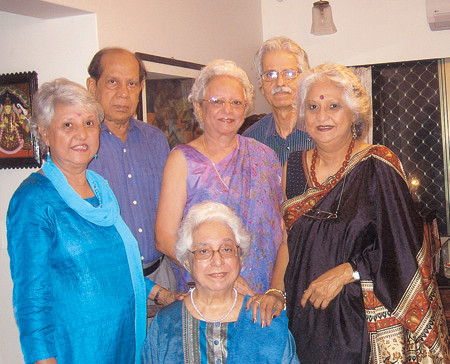
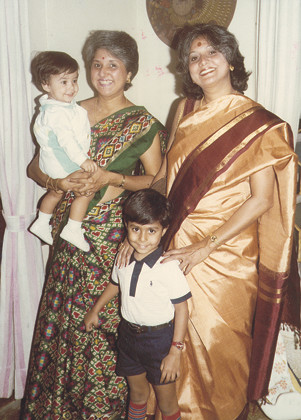
(Above left) Dr Ketayun Dinshaw (right) with her sisters and brothers-in-law; (right) with her twin and nephews in their younger days
According to Dr Roshan Chinoy, former head of the pathology department at the TMH, Dinshaw "took her job extremely seriously and her commitment to TMH was unmatched.” Once she had made up her mind she would brook no arguments. Even though some of her colleagues "didn’t like the decisions she made, they admired her,” added Chinoy. Despite their long-standing friendship, Chinoy recalled the time when Dinshaw interviewed her for the job as head of pathology department. Dinshaw told her in no uncertain terms that she would need to take tough decisions and devote more time if she wanted to assume greater responsibilities. Chinoy then felt she had won "a boss but lost a friend.” But later when Chinoy was diagnosed with cancer, she appreciated that at 11 at night after making the rounds of the Homi Bhabha Block which was under construction, Dinshaw would come by her bedside and hold her hand when she was experiencing the side effects of chemotherapy. "She may not have been a friend in good times but she was always by my side in bad times,” appreciated Chinoy.
Dr Rohini Kelkar, yet another colleague-cum-friend, recalled Dinshaw impressing on her the need to have patience when she sought space for the newly formed microbiology department at the TMH. She also gave Dinshaw credit for initiating the Hospital’s own waste treatment facility and infection control system on their premises. Despite their professional arguments they shared an easy camaraderie, whether shopping for furniture and upholstery for the Hospital or going to concerts.
Working with the government’s many bureaucratic departments Dinshaw knew how to bypass hurdles, stated Zinnia Khajotia, referring to the introduction of the waste management system in the Hospital.
Always seeking to extend the scope of oncology treatment, Dinshaw’s "conviction, courage and determination” to introduce telemedicine and palliative care was commended by Dr Suvarna Patil of the Dr Walawalkar Rural Outreach Program.Terming her a "truly dynamic and charismatic leader,” Dr Hemant Tongaonkar referred to her advice "to be a good human being first and then a professional.” Having known her for three decades he could appreciate that she gave "heartfelt encouragement to the youngsters and had a lot of respect for her juniors.”
Many other juniors recalled "tailing her at the TMH” and learning lessons of compassion and commitment from her for they found her "so sophisticated and yet so simple; warm and down-to-earth.” As commented Dr Rajiv Sarin, who now heads TMC’s research wing in Kharghar, "ACTREC, the Homi Bhabha Block at the Tata Hospital and the Tata Medical Centre in Calutta have her signature inside and outside.” He appreciated too that she made relationships for life and had adopted the large family of TMH. "She reached out to all of us and knew the issues we faced in our individual lives.” As a mark of remembrance, her peers specially planted a sapling on the TMH grounds on the day of the condolence meet.
In her column in The Times of India of September 13, Bachi Karkaria recalled Dinshaw expressing despair when she first set eyes on the barren, inaccessible sprawl of land at New Bombay acquired by the Bhabha Atomic Research Centre. Realizing the work that had yet to be completed she had wistfully conveyed a few months prior to her demise, "If only I had five more years.” Remarked Karkaria, "Kety was as strong at the end as she was at the height of her power; as she’d been even as that clear-goaled teenager in Calcutta.”
After her early education at the Calcutta Girls High School and undergraduate studies at the Lady Brabourne College she had graduated from the Christian Medical College in Vellore and then proceeded to Cambridge to receive her training in radiation oncology. She acquired a diploma in Medical Radiotherapy and was Fellow of the Royal College of Radiologists.
The director is known to have pushed for the development of an indigenous radiotherapy machine and christened it Bhabhatron, for use in India and some developing countries. As the honorary radiation expert on the board of the Department of Atomic Energy (DAE), she continued to make valuable contributions until March this year. Knowing that she participated in the development of the radiation safety code, the DAE representative appreciated that the balancing act must have been difficult for her, being both, a practitioner and regulator of radiation.
Author of over 264 publications, her byline had appeared in national and international journals. Retaining her interest in cancer treatment and literature even during her last days, cancer survivor Devika Bhojwani who was inspired by Dinshaw to start a women’s support group for cancer patients, commented how Dinshaw’s "hunger to know more about cancer was unbelievable.” When her left motor reflexes were affected by the gnawing cancer she accepted Bhojwani’s offer of help and requested her to read aloud from the book Emperor of Maladies. Familiar with the scientific jargon she would correct her pronunciations where necessary and fall asleep when the heavy sedatives took their toll.
"A towering oncologist of global standard… A visionary doctor whose transformation of the TMH and Centre bear her mark… Positive and forthright…with exacting standards,” were some of the encomiums received by Dinshaw. As former ambassador to the US Ronen Sen was quoted by the Times News Network of August 28, Dinshaw epitomized "the motto of the Tata Memorial Centre inaugurated recently by Ratan Tata in Calcutta, namely, ‘state-of-the-art and straight from the heart too’ because cancer cannot be cured by medicine alone.”
With her disarming smile, the soft-spoken Dinshaw had answered Parsiana’s queries with candor and conviction when we had interviewed her during her last year as director (see "The cancer challenge,” January 21, 2008). She had then commented, "It’s a tragedy that this talented community allows itself to remain in a time warp. The rest of the world is moving on...” The prevalent dakhmenashini system, she realized, was unsuccessful in disposing corpses and had hence opted for cremation. Asserting that she had faith in her religion, Dinshaw had told Parsiana she carried the Avesta with her to work, praying from the scriptures in the car. Having lost her mother when she was 11 and her father six years later, she learnt to be independent early in life. Not in favor of reservation of seats being sought for the community, she felt individuals should learn to face competition.
When contesting the Bombay Parsi Punchayet (BPP) elections in 2008 as one of the seven members of the Adult Franchise for Progress, Dinshaw had commented, "The election is about change. We have to change... We are willing to give of our experience, put (our) talent together to make a change.”
As noted Berjis Desai in his obituary in The Bombay Samachar of September 4, "We met Dr Dinshaw for the first time at her office in Tata Memorial to persuade her to contest the BPP elections. Various other personages to whom we made similar requests heaved and sighed, grunted and shunted, tickled within with self importance. Dr Dinshaw in a simple sari and a large bindi on her forehead was a picture of grace. ‘I always wanted to do something for my community. I shall contest,’ she said within minutes. We instinctively knew that she was a gem... In retrospect we were happy that she was not elected... Something about throwing pearls...” After her retirement from TMC she was inducted as trustee of the Masina Hospital to rejuvenate the institution.
Many were the colleagues who commented on Dinshaw’s "elegance and ethnic tastes.” Other acknowledged "her fortitude, strength and grace under pressure.” A stickler for decorum, ethics and punctuality, values she had imbibed from her years in the West, she is known to have annoyed close friends by dismissing their proposals if they were not in the interest of the larger cause. Yet she also exuded warmth, in the best of Indian traditions. As confirmed one of the union leaders in his speech in Hindi, "A sweeper or a surgeon” were given the same respect by her.
The dedicated doctor is survived by her sisters Navaz Jamshed Modi, Dhun Sammy Ayrton, Kamal Nisar Siddiqui and twin Kolly Dara Dubash.