As president of the prestigious, US based Open Society Foundations,
Binaifer Nowrojee strives to protect human rights and dignity
Parinaz Gandhi
In its efforts to globally fight oppression and discrimination, the US based, multibillion dollar Open Society Foundations (OSF), started by philanthropist George Soros, appointed Binaifer Nowrojee as its first woman president. The board’s unanimous decision was announced in March 2024 and she unobtrusively slipped into her new role in Washington DC three months later on June 1.
A votary of freedom, fundamental rights and feminism, Nowrojee is concerned that "the wealth gap is widening. Authoritarians, cloaked in the garb of democracy, are moving to seize power and stifle civil society. Global alliances are fraying, and a multipolar world is emerging.” Involved with this organization for nearly two decades, Nowrojee has been supporting the endeavors of OSF which features among the world’s largest private funders of independent groups striving for human rights, justice and democratic governance.
Top: demonstrators in Georgia protesting government’s move to curb foreign-funded nongovernmental organizations in 2023
Photo: Wikipedia; inset: Binaifer Nowrojee Photo: Maggie Soladay for Open Society Foundations
As commented OSF chair Alexander Soros, "Binaifer embodies the spirit of Open Society, past and present… I have firsthand experience of seeing her in action, in some very difficult circumstances. She is a leader who cares deeply about the people she works with. I am confident she will ably lead the Foundations into the challenging next phase of our work.”

A citizen of Kenya, the US and an Overseas Citizen of India, 60-year-old Nowrojee remarked in an email interview with Parsiana, "I value all my different identities which have deepened my understanding and ability to navigate this world. It is impossible for me to isolate or elevate any single dimension of my identity because it is the intersection of all of them that shapes my experiences.”
Erstwhile lecturer at the Harvard Law School, legal counsel at Human Rights Watch and a staff attorney at the Lawyers Committee for Human Rights, after Nowrojee joined OSF in 2004 she was entrusted with the responsibility of establishing and leading the Foundation in East Africa. Thereafter she served as the Asia regional director before becoming a vice president in 2021. She remembers well her early years at OSF when Kenya was on the brink of a civil war in 2007 and the Foundation supported the mediation efforts spearheaded by Kofi Annan, erstwhile general secretary of the United Nations, that "led to a brokered coalition government, a new Constitution, and accountability efforts for the violence.”
"With over three decades of experience, Nowrojee navigates politically sensitive operating environments to drive meaningful change. Her strategic leadership spans national, regional and international levels,” noted an introduction to the new president on the OSF website opensocietyfoundations.org. Inequality, injustice, insecurity are the realities most humans encounter regularly but few are willing to confront. OSF’s support of such daring endeavors through grant-giving, research, advocacy and litigation is a "privilege,” according to Nowrojee who commends those "improving the world for all of us.”
Nowrojee (l) in discussion with local anti-violence activists in Valle del
Cauca Colombia Photo: Jair Coll for the Open Society Foundations
Above: Nowrojee (l) with Alexander Soros
Photo: Niklas Hallen/Factstory for the Open Society Foundations;
inset: George Soros Photo:opensocietyfoundations.org
George Soros commenced his philanthropic work in 1979. Having experienced ethnic and political intolerance as a young Jew during the Nazi occupation of Hungary, after the end of World War II, he left Hungary that was being controlled by the Communists. After relocating to London, he worked part-time as a railway porter and as a night club waiter to support his studies at the London School of Economics. In 1956 he emigrated to the US to make his fortune through finance and investments. Over the last 45 years he has contributed more than $ 32 billion (Rs 2,67,056 crore) to OSF to continue its work in 120 countries. "This organization has stood in solidarity with the marginalized and oppressed, starting with Black students in apartheid South Africa, the besieged citizens of Sarajevo, the brave dissidents in communist Eastern Europe, the Rohingya driven out of Myanmar…” the new president named some of the causes with which OSF has been involved.
As president, Nowrojee expects to "engage with a diversity of actors… our peers (as also) political and civil society leaders.” The perceptive and articulate president is confident that through "active sensing of global signals and trends, we will be better able to solve real-world problems.” She laments that "climate change and human catastrophes are upending societies. Culture wars and conflict zones are breeding ethno-nationalism, religious fundamentalism, and increasing repressive, closed societies. Technology brings innovation, and also disruption. Hyperpolarization is collapsing the space for constructive politics and further accelerating dogmatic extremism. There is a global renegotiation of power in a world shaped by new centers of influence.”
Rather than be dissuaded by these disturbing global trends, to secure a better future OSF has chosen to resolutely "stand firm to collectively advance human rights and dignity; support inclusive political leadership; and advocate for national and global governance systems to be more equitable… In that undertaking, we must include women every step of the way,” asserted Nowrojee.
"A gender-just future cannot become a reality without support for the courageous and transformative feminist leaders around the world who are making this happen,” Nowrojee had written in an article last November for "Voices” featured on the OSF website. Concerned that state-sponsored disinformation campaigns suppress and intimidate female advocates who champion democracy, OSF committed $ 25 million (Rs 208.69 crore) to start the Women’s Political Leadership Fund. This initiative is meant to identify and help women "to enter politics, succeed in governance, and sustain their influence in formal electoral and other political settings. The Fund will connect them with one another to provide support networks and strategies to respond to, overcome, and end violence against women in politics.” Nowrojee cited a report from the Women Political Leaders network according to which "significant representation of women in political leadership improves a country’s overall progress, particularly in ensuring economic equality.”
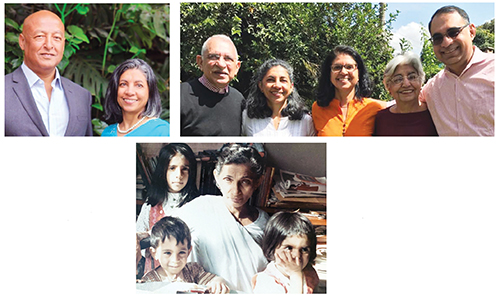
Top (from l): Gabriel Abraham and Binaifer; Pheroze, Binaifer, Anahita Sia, Villoo and Elchi Nowrojee;
above, clockwise from rear l : Binaifer, with paternal grandmother Tehmina, Anahita Sia and Elchi
Working in six geographical regions — USA, Latin America and the Caribbean, Europe and Central Asia, Middle East and North Africa, Africa, Asia Pacific — OSF focuses on four principal areas: equal treatment for all, irrespective of ethnicity, religion, gender; access to justice and the rule of law; freedom of expression, privacy and access to information; the unequal burden of the climate crises. "We identify and prioritize our regional, global and cross-program collaboration in a manner that has maximum impact, where it is most needed and where we can bring support not available from other funders,” mentions their OSF website.
"Instead of submitting to our fate, we resisted an evil force that was much stronger than we were,” George Soros regularly reminds his colleagues of the lessons he learnt as a teenager to outlive Nazi persecution. It is the same approach he would like to infuse in them "to counter the narrow pursuit of political self-interest and short-term opportunism.” Drawing inspiration from the philosophy of Karl Popper, he chose the path of universalism to improve the world even though not everyone agreed with the concept of open societies.
Referring to the founder’s magnanimity, Nowrojee explained, "Giving of his fortune has been shaped by the belief that open society values underpin economic prosperity and political stability, and are the strongest defense against autocracy. His vision is based on the belief that no one has a monopoly on the truth. And he has never shied away from risk, calling his foundation ‘political philanthropy.’”
Nowrojee’s values and principles have been influenced by her family, upbringing, education and religion. Her father Pheroze is a constitutional lawyer, writer and poet in Kenya, mother Villoo is an educator and child rights advocate, sister Anahita Sia is a senior director at the United Nations Foundation and women’s rights advocate, and brother Elchi is managing director of the Carlyle Group. Married for the last 31 years, Binaifer’s husband Gabriel Abraham is an architect and urban planner who has worked on historical preservation, decentralization of municipal services and as a government advisor.
Binaifer completed her secondary schooling in Nairobi, BA from Bryn Mawr College in Pennsylvania state, juris doctor from the Columbia Law School and masters in law from the Harvard Law School. She was awarded a fellowship from Harvard University’s Carr Center to interview Rwandan rape witnesses on their experiences with international justice. "One of my most significant professional contributions has been the prosecution of sexual violence crimes under international law,” stated Binaifer. As a member of the International Coalition for Women’s Human Rights in Armed Conflict, she worked in an advisory capacity with prosecutors at both the International Criminal Tribunal for Rwanda and the Sierra Leone Special Court, gave her testimony and statements as witness, and analyzed a database of evidence from rape victims and witnesses.
When asked about her ethnic and religious roots, Binaifer is proud to identify herself as a Parsi even though she has enjoyed few interactions with the Parsi community. "I grew up in Kenya where there was a small Parsi community that meets on religious occasions. Since I don’t live in India, my opportunity to interact with Parsis is limited, but I can always spot a Parsi and am happy to connect. My best experience was when I moved to Singapore and the Parsi community gave me the warmest welcome,” she recalled, adding, "I don’t have a lot of spare time at the moment to engage in Parsi community activities, but I will never pass up an opportunity to eat dhansak and patra ni machhi!”
An issue that continues to vex her is: "Why are Parsi women married to non-Parsis not able to pass down their (ethnicity) to their children if Parsi men can? I would like to see gender parity applied in how we recognize children born of families with one Parsi parent.”
The core of Zoroastrianism — "good thoughts, good words, good deeds — has influenced my life choices,” states Binaifer. "I also relate to the seven Ameshaspands: wisdom, peace, truth, courage, love, perseverance and awareness. While ceremonies and prayers are an important part of any religion, I believe that religious faith is best demonstrated in the way you live your life daily. Let us be judged on how we carry ourselves in this world.”