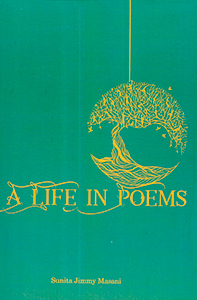
A Life In Poems by Sunita Jimmy Masani. Published in 2022 by the author, Hem Kirti Building, 3rd floor, 6, Bomanji Petit Road, Bombay 400036; email: sunitamasani@gmail.com. Pp: 62. Price: Rs 350.
Lawyer, teacher, counselor for students and adults, and sailing enthusiast, Sunita Jimmy Masani (pictured) wears many hats. These varied experiences find expression in her elegant book, A Life In Poems. Divided into four parts, The Haiku period, the Romantic period, the Vipassana period and During Lockdown, the poems span three decades, and reflect the philosophical and ruminative sensibility of the author. The volume of poems is "dedicated with warmth/To all those having/loving eyes and compassionate hearts” — an invitation to the reader to absorb the essence of the poems, and to allow his/her individual consciousness to merge with the greater cosmic energy.

Masani tells us that she has drawn on Pinterest for many of the visual images which juxtapose the poems, particularly the haikus. Haikus, short poems which are Japanese in origin, have traditionally a seven/five/seven syllabic structure. Though the poet does not stick to this rigid structure, her haikus do, like the original, encapsulate a mood, a feeling, a sharpness of perception. The first haiku in the volume, "In the deepening dusk/Metal clashed metal.../The ancient rock smiled at folly” is written under a stark but graceful illustration of a samurai warrior, his sword, a powerful arc, emphasizing the idea of the folly of war and the unchanging quality of solid rock; a lonely, retreating figure of a monk in red with a large red umbrella, looking into an endless corridor of tunnels in shades of brown illuminates the occasional emptiness or mystery of life in the little poem, "After traversing the tunnel/He found/Darkness beyond.” This reviewer’s personal favorite is an illustration of the rear view of a lone Japanese figure in a kimono on top of a mountain, looking out at the great beyond with the lines "From the Great/Unto the Great Great Deep.../Alone” — which distils the essence of our journey through life and the unknown.
The Romantic period, 1990 to 1998, which has poems without illustrations, gives us a glimpse of the author’s own relationships with both the human and the divine. Written in a free-flowing form, these verses explore the transitoriness and pain of earthly love, "A puff of smoke/ln the palm of my hand,” or of betrayal, but also speak of the "glow” that appears after moving upward "until it merges with ether,” a metaphor for the soul’s yearning for oneness with the infinite. These poems, as well as the ones in the section Vipassana period (1993 onwards), are more dilatory in nature, often spelling out for the reader the meaning of the verse, as in "Bound to the Bond”: "Today brings the shift —/The realization that by remaining Equanimous,/Merely a passive observer/I dilute the attachment./Working Vipassana Actively.”
"Confounded,” on the other hand has a charming, even playful tone that asks, "Does the Devil only wear Prada/Why not
Versace/Whilst deliberating on/The fundamentals of Nietzsche?” The same poem ends with the relationship between the reader and the poet, "The writer creates from imagination for the reader to interpret/And they both enjoy the fun when the deed is done!”
Indeed, the "fun” for the reader continues in the last section, During Lockdown, where Masani goes back to what I consider her forte — the haiku. Once again, images and words set off each other in harmony. A painting of monks in fluid blue robes with blue umbrellas subtly illustrates the delicate images: "On a carpet of almond blossoms/They walk…/Beauty in surrender,”
and a Chinese or Japanese painting of pale brown mountains against a cream background inspires the Vipassana like haiku: "Like melting snow/Dissolve disintegrate anxiety.../Observing pure breath.”
One might ask which came first, the painting or the verse? But that’s a specious question, as the painted image and the verbal one seem to be intrinsically linked in a dancing swirl of color and rhythm. These are poems which need to be read slowly and savored as their meaning gradually unfolds itself to the reader.
SHIREEN J. VAKIL
Vakil has taught English literature and language for 36 years at the Elphinstone and Sophia Colleges. She has done a PhD on the poetry of Seamus Heaney.