The admiration he evoked from achievers and strugglers, the encomiums earned, the state funeral accorded to Ratan Tata on October 10, 2024 were a reminder of his popularity, his persona and his values. The passing away of the iconic industrialist at Bombay’s Breach Candy Hospital the previous night and the subsequent shift of the body in a flower bedecked hearse, first to his residence at Colaba, thence to the National Centre for the Performing Arts (NCPA) complex and finally to the Worli crematorium saw thousands pay their last respects. This included those fortunate to have interacted with the chairperson of the Tata Trusts and erstwhile head of the Tata Group that encompasses nearly 100 companies. Even those who had only seen his visage in newspapers and posters were willing to stand in long queues to catch a glimpse of the esteemed 86-year-old leader who had not lost the common touch.
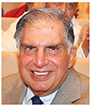
Two parallel streams of visitors and Tata employees came to honor the leader at the NCPA where his body covered in a white shroud lay in a glass coffin, a crimson topi covering the head. When the 24-gun salute was given to the deceased on the grounds of the Worli crematorium, the national flag was draped over his body in a wooden coffin. During the geh sarna prayers performed at the Worli Prayer Hall, seated in the front row were Union home minister Amit Shah and State leaders including chief minister Eknath Shinde. Just before the coffin was carried into the crematorium, shouts of "Ratan Tata amar rahé (live eternally)” and "Bharat mata ki jai (Hail Mother India)” rent the air.
Social media too was buzzing through the day. The President of India Droupadi Murmu remarked of Ratan, "India has lost an icon who blended corporate growth with nation building and excellence with ethics. He inspired seasoned professionals and young students alike.”
Prime Minister Narendra Modi described Ratan as "a visionary business leader, a compassionate soul and an extraordinary human being, He provided stable leadership to one of India’s oldest and most prestigious business houses.” A month after Ratan’s passing, Modi recalled the instances when they had worked together and added, "(His) patriotism shone brightest in times of crisis. His swift reopening of the iconic Taj Hotel in Mumbai after the 26/11 terror attacks was a rallying call to the nation — India stands united, refusing to yield to terrorism… He remains alive in the lives he touched and the dreams he nurtured. Generations will be grateful to him for making India a better, kinder and more hopeful place.”
Top: Ratan Tata
Photo: Jasmine D. Driver
Above: accorded a state funeral
Photo: Hormazdiyaar Vakil
Tata group chairman N. Chandrasekaran who viewed Ratan as his mentor declared that he was a "truly uncommon leader whose immeasurable contributions have shaped not only the Tata Group but also the very fabric of our nation.”
When Ratan took over the reins from J. R. D. Tata in 1991, "JRD got clubbed with nepotism and I was branded as the wrong choice,” the successor had candidly confessed. By introducing significant changes in the then unwieldy Tata empire, enforcing a retirement age and promoting youngsters to senior leadership positions, taking charge of Tata Steel to make it a modern steel company, making subsidiaries report to the group office, and setting up Tata Teleservices in 1996 he consolidated the Tata Group under a new logo.
During his 21 years at the helm, Ratan embarked on globalization of some businesses nurtured by Tatas by daring to venture into a string of high-profile acquisitions and saw the Tata brand stamped on icons such as Tetley, Corus Group and Jaguar Land Rover (JLR). Tata acquired JLR in 2008 from Ford Motor Company for £1.75 billion (Rs 188 billion), a year after it had taken over British steelmaker Corus for £ 6.2 billion (Rs 664 billion), it was recalled in the Coventry Telegraph of October 18. The newspaper credited him with "helping secure the future of JLR and creating thousands of jobs in Coventry and the West Midlands.” Leader of Coventry City Council, councillor George Duggins remarked that "through his support to regenerate JLR and his role in establishing the National Automotive Innovation Centre at the University of Warwich, his contribution to the regeneration of Coventry cannot be underestimated.” Former West Midlands mayor Andy Street mentioned, "Rarely does a businessman change the world like Ratan Tata did. JLR and the West Midlands would not be what they are today without Ratan. We will forever be indebted.”
Describing him as "one of India’s most powerful and admired magnates,” according to The New York Times obituary "the Tata Group’s profits multiplied 50 times” during the 21 years he steered the conglomerate.
While India had conferred on him the Padma Vibhushan, the nation’s second highest civilian award in 2008, in the UK he earned the GBE (Knight of the Grand Cross of the Order of the British Empire) in 2014 for services to UK/India relations, inward investment to the UK and philanthropy.
Some of his ambitious dreams like manufacturing the affordable car Nano misfired, compelling closure of this car manufacturing facility after a decade. Ratan was also under criticism in 2016 when he ousted his handpicked successor Cyrus Mistry as chairman of Tata Sons, a decision that resulted in a protracted legal battle and divided loyalties between the Tata family and the Mistry family of Shapoorji Pallonji and Company that had an18% share in Tata Sons, the principal investment holding company and promoter of Tata companies.
Above, l: Ratan Tata receiving Padma Vibhushan from
President Pratibha Patil Photo: Wikipedia;
r: at the Iranshah Udvada Utsav (from l): Dastur Khurshed Dastoor, Ratan,
Arun Jaitley, Dr Cyrus Poonawalla Photo: Jasmine D. Driver
Noel (l) and Ratan Tata
Photo: Jasmine D. Driver
Once he brought in Chandrasekaran as the new chairman of Tata Sons, Ratan took a backseat in the Tata Group’s business decisions but continued to head the Tata Trusts and in his individual capacity became a prominent investor in nearly 50 Indian startups like Paytm, Ola Electric and Urban Company, especially in the sectors that he espoused. His favorite was a startup called Goodfellows which encouraged friendships between older and younger Indians and at its launch two years ago told an intergenerational audience, "You don’t mind getting old until you get old and you find it’s a difficult world.”
"He is an example to big business, small enterprise, to researchers and developers, those who give and those who can give more. We believe that he will be an example to our students as they grow to become global citizens,” stated Prof Dame Nancy Rothwell, chancellor of The University of Manchester, when conferring on Ratan an honorary degree of enterprise in 2020. In the same year, the Bombay University appointed him chairman of its advisory council.
Raised by his paternal grandmother Lady Navajbai Tata, Ratan had noted in an interview, "I had a happy childhood but as my brother (Jimmy) and I got older, we faced a fair bit of ragging and personal discomfort because of our parents’ (Naval and Sooni) divorce.” Ratan’s education was at the Cathedral and John Connon School in Bombay, the Riverdale Country School in New York City, and the Cornell University in Ithaca, New York from where he earned a degree in architecture although his father wanted him to study engineering. He later took courses in management at the Harvard Business School. On his return to Bombay in 1962, he started working with the Tata Group, gaining experience at TELCO (Tata Motors), Tata Steel, National Radio and Electronics Company (NELCO). He was selected for the chairman’s role in 1991.
A bachelor, Ratan disbursed much of his personal wealth on education, health and environmental projects for the disadvantaged Indians. Overseas, he and Tata Trusts contributed millions of dollars to several universities, including his alma maters, for research and scholarship programs that bear the Tata name. "Even more pronounced than his economic successes, he shaped the philanthropic and charitable sectors that have uplifted millions of impoverished people and brought them back into the mainstream of society,” observed Dinshaw Tamboly, chairman of The WZO (World Zoroastrian Organisation) Trust Funds.
His canine friends, pets as also strays, knew they could count on him for care and attention. The specialty pet hospital, Small Animal Hospital Mumbai at Mahalaxmi that he was instrumental in founding opened its doors just four months ago. In fact, one of Ratan’s associates likened the dog lover to a "trained bloodhound; he would never give up on his vision no matter how many deterrents he had to overcome.”
Not known to be a socialite, among the few indulgences he permitted himself were driving his convertible cars, occasionally flying the company plane, being a licensed pilot, and sailing out in a speed boat. His favorite restaurant was Thai Pavilion in Hotel President, revealed Goodfellows founder Shantanu Naidu who enjoyed a rare friendship with Ratan and had penned his memoirs in I came upon a lighthouse. Five generations of Naidu’s family have been working with Tatas and his great-grandmother would regularly light incense sticks before a photo of the founder Jamsetji Tata every evening in their home, it was mentioned in the book.
Memorial and prayer meets convened by: (top and 2nd row, l) Bombay Parsi Punchayet;
(r) Navsari Anjuman; (3rd row, l) Surat associations; (r) Vadodara Panchayat;
(4th row) Zoroastrian Trust Funds of Europe;
(5th row) Karachi’s Behrana and Wadia Dar-e-Mehrs
An indelible mark
Ratan rarely attended Parsi community events. When felicitated at the Iranshah Udvada Utsav in 2015, Ratan had remarked that he was "overwhelmed with emotion to receive this recognition. It humbles me when I am amongst you… I am proud to be a Parsi and a Zoroastrian… (seeing) what small numbers did in their adopted country... Excel in what you do... We have a tradition of leadership and have contributed to this country.” When present at the Ministry of Minority Affairs and Ministry of Culture convened event in Delhi to mark the inauguration of The Everlasting Flame International Programme in 2016, Ratan was but a silent spectator seated in the front row.
Even then, his life and work left an indelible mark on the minds and hearts of the community in India and across the globe who had uthamna, prayer and memorial meetings in his honor. The Bombay Parsi Punchayet (BPP) convened condolence meeting on October 27 on the lawns of Rustom Baug when senior Tata executives who had worked with Ratan shared insights of his democratic, empathetic and syncretic style of functioning. The resolution passed by the BPP stated, "He was the epitome of many of the qualities and characteristics which the Parsi community is well known and respected for and strode like a colossus across the global business community…He championed sustainable business practices, integrating environmental considerations into the very fabric of the group’s operations.”
Under the auspices of the Samast Parsi Anjuman of Navsari, an uthamnu and homage meet was organized on October 11 at the Sirvai Party Plot at the Parsi Boys Orphanage attended by thousands of well-wishers and admirers including political and government officials like the finance minister of Gujarat Kanubhai Desai, the collector, senior municipal officials, police officers and district education officers. Likewise at a meeting convened by the Valsad Parsi Anjuman Trust, members of the community, including Dastur Khurshed Dastoor, representatives of various faiths, police officers, and others offered rose petals before his photo frame.
The Surat Parsi Panchayat, The Parsee Pragati Mandal, Surat Parsi Gymkhana, Sheth P. K. Kadim Atashbehram, Bag-e-Parsa Adarian and the Zoroastrian Women’s Assembly of Surat organized a joint prayer meet on October 13. The Parsi Panchayat Charitable Fund Vadodara held a maiyat nu jashan on October 20. Uthamna prayers were also organized at the Kadmi and Shenshai Agiary in Poona.
Across the shores, in Karachi a memorial prayer meet was jointly held by the trustees of Behrana Dar-e-Mehr and Wadia Dar-e-Mehr on October 20. The jashan was performed by all seven priests in Karachi with all three halls of Wadia Agiary occupied by devotees.
In London, the Zoroastrian Trust Funds of Europe conducted an uthamna and prayer meet on October 11. It was attended by Lord Karan Bilimoria who had worked with Tata since 2002 and had witnessed his resilience during the global financial crisis in 2008, Mehrnavaz Avari, UK area director of Indian Hotels Co, Tata employees, past and present, as also dignitaries from the UK High Commission and representatives of other faiths.
As noted a communiqué from the Federation of Zoroastrian Associations of North America, "Ratan Tata lived a life of humility and quiet strength, eschewing the spotlight while championing causes close to his heart. His deep commitment to the Zarathushti ethos of compassion and charity, combined with his belief in modernity and progress, made him a bridge between the past and the future, both for the Tata Group and for India.” Other Zoroastrian associations in USA and Canada too like the Ontario Zoroastrian Community Foundation recalled Ratan’s contribution in building up the Tata "conglomerate with interests in much of industrial India, from tea to tech, power to petrochemicals…”
"Very few people live true to their name. Ratan was indeed a gem of the community,” was the general opinion within the community. There were some who were critical of the orthodox anjumans and agiaries that had prayer meets in his memory knowing well that prayers at agiaries are otherwise not permitted for the first four days for those cremated. "Because it is (Ratan), his choice to be cremated stands forgiven… Mota ghér nu badhu vanaijai (lapses in affluent households are not condemned),” stated one community activist and observer.
In their personal space individuals reacted differently to news of his demise: one Parsi lady changed her WhatsApp display photo to show Ratan. Another young girl spent hours creating a massive rangoli of Ratan as shared on WhatsApp. His death coinciding with the Navratri celebrations in Bombay, one night the loud music and dancing was momentarily suspended as a tribute to his memory. Among the caricatures on social media was an illustration of Jamsetji Tata in heaven hugging Ratan with the words "You made me proud Ratan…” while a bemused JRD and two dogs witness the embrace.
Ratan is survived by his younger brother Jimmy, stepmother Simone, half brother Noel, and half sisters Shireen and Deanna Jejeebhoy.