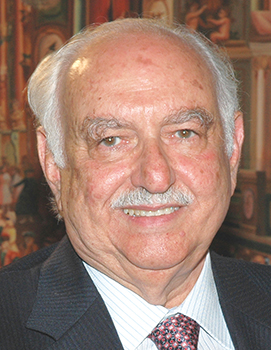
Some were in awe of him as the oldest billionaire in India who was repeatedly listed among the 10 richest men in the country. Others admired him for his humility and grace. All agreed that the business acumen and philanthropy of Pallonji Shapoorji Mistry, the erstwhile chairman of Shapoorji Pallonji and Company Ltd (SP) were phenomenal. With his passing away in Bombay at the age of 93 years on June 28, 2022, the media featured accolades from the heads of state, business barons as also those whose lives he impacted with his known and unknown deeds of charity.
The President of India Ram Nath Kovind viewed him as the "doyen of infrastructure and building industry,” adding, "His contribution to wealth creation and nation building will be long remembered.” Prime Minister Narendra Modi too appreciated Mistry’s "monumental contributions to the world of commerce and industry.” Six years ago he had been conferred the Padma Bhushan, the nation’s third highest civilian honor.
The venerated businessman was accorded a ceremonial funeral by the police personnel prior to the final rites as per Zoroastrian customs at Doongerwadi. The flag of India laid on his torso, Mistry’s body was carried by police personnel from the hearse to the portico outside the Albless Bungli where it was laid on a stretcher. The traditional guard of honor, gun salute, reversed arms and the playing of The Last Post on the bugle were witnessed by his family, friends and associates who had come to pay their last respects as also those who saw the video clips shared on WhatsApp.
At the inauguration of the 12th World Zoroastrian Congress in New York on July 1, the assembly observed a moment’s silence as a mark of respect to the benevolent businessman.
"He was a hard core entrepreneur with foresight and tenacity to see his dreams come true,” wrote Jimmy Parakh, recalling the time he was interviewed by "Pallonji Seth” nearly four decades ago for the job of financial controller. "He virtually knew most of his employees by name. His humility set him apart from many other business heads and working with him was always a pleasure… Generally all his offices had a sea view... The culture of business ethics that he inculcated in his businesses still holds good for the entire group,” added Parakh who continued his association with SP for 34 years.
Pallonji held the reins of SP for 37 years, from 1975 following the death of his father Shapoorji until 2012 when he passed on the baton to his elder son Shapoor. At the company, started as Littlewood Pallonji and Company by his grandfather Pallonji in 1865, the third generation Pallonji was known to be an astute businessman and quick to spot new opportunities that India’s industrialization and growing economy presented, as noted a press release from the company detailing his manifold contributions to diverse businesses from construction to real estate to industry to infrastructure to trading to power generation to information technology and other sectors.
Top: Pallonji Mistry Photo: Sarosh Daruwalla, Mazda Studios;
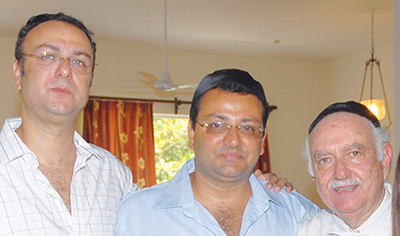
above: with sons Shapoor (l) and Cyrus Photo: Nazneen K. Vajifdar, Spectravision Labs
Clockwise from top, from l: Homa and Aban Petit, Shapoor, Pallonji, Patsy and Cyrus Mistry,
Hector Mehta, Zarir Bhathena; Pallonji Shapoorji Home for Senior Citizens of The B. D. Petit Parsee
General Hospital, Photos: Nazneen K. Vajifdar, Spectravision Labs; Muscat Palace Photo: Wikipedia;
Iranshah after its restoration in 2021 Photo: Divya Cowasji
An alumnus of St Xavier’s School and St Xavier’s College, Pallonji joined SP in 1947 at the age of 18 years and assisted his father to expand their construction business. With his incredible foresight, confidence and determination the son ventured abroad in the late 1960s when construction in the Middle East was booming. The company won a tender to build the palace of Sultan Qaboos bin Said al Said in Muscat. The first Indian construction company to have completed an overseas project, when the palace was opened to the public in 1975 it was hailed as a construction marvel and served as a launching pad for SP to consolidate its presence in the Middle East. Thereafter the company forayed successfully into Africa where it executed several landmark projects such as the Presidential Office of Ghana, the National Assembly of Gambia and the Ebene IT Park in Mauritius which have won international accolades and provided employment opportunities to Indians.
Under his chairmanship, SP acquired strategic stakes in companies like Sterling and Wilson, United Motors, Forbes Gokak and Afcons Infrastructure which he brought under the banner of the SP Group reportedly one of India’s largest private enterprises employing over 70,000 staff.
Outside of the charitable trusts, Pallonji’s ownership of 18.4% made him the single largest shareholder in Tata Sons, the holding company of the Tata Group. His presence being more felt than seen, Pallonji had earned the sobriquet "Phantom of Bombay House.” Besides being on the board of Tata Sons, over the years he also served on the boards of other organizations like the Associated Cement Companies Ltd where he was chairman, Union Bank of India and the W. H. Brady Group of Companies.
"His commerce was always with a conscience,” read a tribute from Sri Shanmukhananda Fine Arts and Sangeetha Sabha acknowledging, "He gave expression to the dreams of Mumbaikars to have a large, state-of-the-art auditorium in the city… constructed at just about Rs 32 lakhs… When the Sabha could not pay even that amount in full, he waived off the balance.” Mughal-e-Azam, one of Hindi cinema’s most popular classics, produced by his father Shapoorji, was re-released in color by the family in 2004, and later resulted in a stage version being performed at the National Centre for the Performing Arts.
In the field of sports too Pallonji created a lasting impact. As recalled sportswriter Gulu Ezekiel in mid-day, July 4, 2022, "It was 10 years after (Pallonji) took Irish citizenship in 2003 — his wife Patsy was born in Dublin — to become the richest man in Ireland that he used his vast wealth to fund Irish cricket from grassroots. In Dublin he established the Shapoorji Pallonji Cricket Ireland Academy… This was a multi-million euro 10-year deal signed between the construction giant and Cricket Ireland, and made the Group the official partner to Cricket Ireland…”
Members of the Zoroastrian community too repeatedly benefitted from Pallonji’s largesse. When the SP Group celebrated its 150 years in 2015, all Zoroastrians were invited to a lavish gahanbar at the Turf Cluf at Bombay’s Race Course that was attended by over 6,500 community members. Similar gahanbars for Zoroastrians had been hosted by the Mistrys at their Infocity campus in Poona.
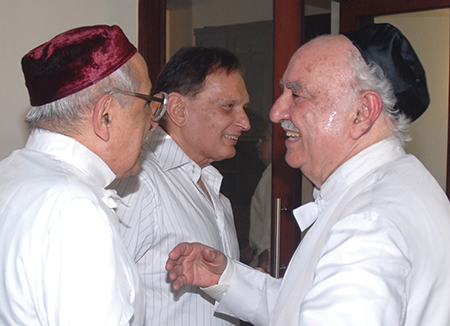
From l: Fali Nariman, Dr Farokh Udwadia and Pallonji Mistry
Photo: Nazneen K. Vajifdar, Spectravision Labs
The SP Group had contributed Rs 50 lakhs to the Bombay Parsi Punchayet’s (BPP) Venture Capital Fund to encourage budding entrepreneurs. When the World Zarathushti Chamber of Commerce conferred its honorary membership on Pallonji in 2005, then BPP chairman Minoo Shroff ascribed the business magnate’s success to his "great knack for picking the right advisors, his nose for opportunity, his ability to exit unviable businesses at the right time and his non-overbearing, very approachable manner.” At the felicitation the usually reticent tycoon had stressed: uphold the name of the community in business and in the professions as we have in the past, maintaining high standards of business ethics; be bold, be risk takers, be flexible, intuitive, trust your gut feelings; commitment, hard work and dedication will take you forward (see "Building a world enterprise,” Parsiana, May 7, 2005).
"Though a colossus in the world of commerce and industry, he was a genial, gracious and generous philanthropist,” commented Homa Petit, president of The B. D. Petit Parsee General Hospital. Ever since the three-storey Pallonji Shapoorji Home for Senior Citizens of The B. D. Petit Parsee General Hospital was opened in 2006 following a magnanimous donation by Pallonji and his family, Pallonji and Homa would serve as its chairman by rotation. "When he was chairman, he used to make me sit beside him and after discussion and decision on an important agenda item, he would turn to me and say in Gujarati ‘Barabar chhè ni (isn’t it correct?).’ Then at the end of every meeting he would ask if I was happy with everything. As we were leaving, he would meet the residents who were in the dining/common room and enquire if all was well. He was truly one of the last of the benevolent sethias of the community, undoubtedly a man who lived by the principles of simple living and high thinking,” appreciated Homa.
In March this year Masina Hospital inaugurated its 14-bed renal dialysis center that was funded by Shapoorji Pallonji Investment Advisors Pvt Ltd. The Mistry family is known to have a four-generation nexus with the Hospital, starting with Pallonji’s father. Son Shapoor is currently a trustee and grandson Pallon who was present at the March function assured the Hospital management of SP’s continued support.
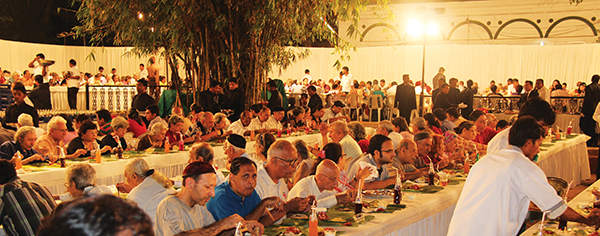
Gahanbar hosted by the SP Group in 2015 Photo: Jasmine D. Driver
Besides healthcare, the cause of Zoroastrian education too was promoted by the Mistry family that five years ago contributed five million pounds (Rs 42 crores) towards the setting up of the Shapoorji Pallonji Institute at the London University’s School of Oriental and African Studies (SOAS). As stated on the SOAS website, "Mistry was an incredibly generous individual... We are very proud to have a bust of Mr Mistry outside of the SOAS Shapoorji Pallonji Institute of Zoroastrian Studies (on the third floor of the Philips Building) to celebrate the progress that has been made in his name. His legacy and generosity will live on here at SOAS.” Prof Adam Habib, SOAS director, issued a statement acknowledging, "The family’s generosity has enabled the teaching of Zoroastrianism at SOAS, countless scholarships, as well as research projects and summer schools over the past five years.”
Describing him as an "exemplary Zoroastrian,” Dastur Khurshed Dastoor of Udvada observed, "Though a billionaire, he was a simple man with deeply rooted religious ideologies. He would be seen here in Udvada, immersed in prayer and absorbing the tranquility and magic of the holy fire… I have been fortunate to have interacted with this astute gentleman in Udvada on his bi-yearly visits during mah Ardibehesht and mah Adar… I can’t thank the Pallonji Mistry family enough for the mammoth task they took up to restore the Iranshah Atash Behram building to its original form and glory last year. When I went to their office in Bombay with a request for help, he asked his son Shapoor who was also present to leave no stone unturned and do his very best to restore the Iranshah makaan (building)… The Zoroastrian community owes its gratitude to this iconic figure and his family.”
The family also being regulars at the Dadysett Atash Behram in Bombay, nearly two decades earlier SP offered to assist the cash strapped Dadysett Charity Trust by building a seven-storey building in place of the old Dadysett House on the Atash Behram property. The Rs 2.5 crore project was meant to house low income families and mobeds on a leave and license basis. Vociferous opposition from orthodox sections of the community made the SP Group withdraw its offer. Son Shapoor is currently trustee of the Dadysett Charity Trust.
In a fleeting interview with Parsiana, Pallonji had then commented, "The community needs to be more broad-minded otherwise we will more or less disappear.” When Parsiana’s liberal stance resulted in some advertisers and subscribers withdrawing support, the SP group’s continued faith in the magazine’s policies served as a reassuring morale booster.
The pragmatic Pallonji is survived by his wife Patsy, daughters Laila Rustom Jehangir, Aloo Noel Tata, sons Shapoor and Cyrus, and sister Nergish Munchi Adenwalla.