A digital platform that will collect, preserve, organize and
share Zoroastrian material is being planned as the legacy project
of the 12th World Zoroastrian Congress
Parinaz Gandhi
"At the end of each Congress we need to reflect on what we leave behind. Legacy projects are creative endeavors with the intention to leave something meaningful for those who come after us,” stated co-chair of the 12th World Zoroastrian Congress (12WZC) Astad Clubwala at the concluding session on July 4, 2022. Expounding on Zoroastrian Footprints as the legacy project of 12WZC, he shared its vision of a multilingual, global, digital platform that will "collect, preserve, organize and share all things Zoroastrian from all available sources to provide a rich resource for the community and ensure that this information is available for posterity.”
"There is a wealth of information on social media but it disappears. What will happen to the print media 10 years from now? It is important to capture this information,” emphasized Clubwala. Perturbed by articles titled "The last of the Zoroastrians” or "Two decades from now Pakistan will have no Parsis,” or news bytes stating, "In more than 50 of the 80 towns in India where Parsis once lived the anjumans or associations are defunct,” Clubwala attempted to verify reports. He reached out to different Zoroastrian pockets with a request that they write a brief history of their community: Who were the first Zoroastrians in their area? Their occupations? The associations founded? The community statistics during its heydays and currently? They were also encouraged to send visuals of every Zoroastrian structure be it a residential building, agiary, dharamshala, school, hospital, business, hotel, burial ground, statue, street sign…
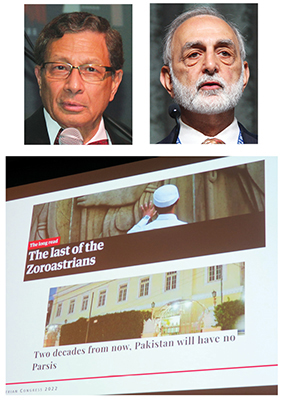
Top: Astad Clubwala (l) and Homi Byramji;
above: disturbing headlines that make news Photos: Jasmine D. Driver
Clubwala’s introductory remarks on Zoroastrian Footprints had visuals of inputs he had received from Karachi and institutions in Madras, the two communities with which he had connections before making his home in New York. He was president of the Zoroastrian Association of Greater New York for 10 years, trustee of the Arbab Rustom Guiv Dar-e-Mehr Zoroastrian Temple for eight years and is hereditary trustee of the Jal Phiroj Clubwala Dar-e-Meher in Madras. Professionally he is president of his company Hudson Ethics 2 LLC which provides consultancy services to the ethics offices of a number of United Nations agencies.
"Today’s event is tomorrow’s history so we should preserve it. We need to capture what has happened and what is happening — in the motherlands and in the diaspora — worldwide,” stressed Homi Byramji who is spearheading this project alongside Clubwala. Credited with creating the world’s first touch-tone input and synthesized voice response application, Byramji has been the chief executive officer and board member of several public and private companies and charitable organizations. As senior vice president of Thomson Reuters he managed over 3,000 people around the world. He is known to have championed the advertising supported electronic dissemination of financial information on the web. Currently he is engaged in using ecotourism and sustainable development to preserve a wildlife refuge in Nicaragua and to improve the lives of the people in the area.
Byramji referred to his interactions during the Congress with some delegates, one of whom said, "I have boxes of information” and another stated, "I have tapes of my grandmother talking about her life.” Familiar with technology that can convert voice recording to text, Byramji felt such archival information can be digitized. "There is a clear need to aggregate, integrate, enrich and preserve the content as a wonderful resource for Zoroastrians today and in the future,” he asserted.
"It is vital and of historic importance to capture all available information” connected with Zoroastrians in the domains of religion, culture, literature, arts, sports, food, even jokes, emphasized Byramji. "We have to keep adding in perpetuity…” Since Zoroastrians speak different languages, Zoroastrian Footprints needs to be multilingual. He referred to Dr Rashna Writer’s words at the Congress: "Language is an identity marker” when urging the delegates to learn Dari that is spoken in Yazd and other parts of Iran.
"We will lawfully accumulate and index information from sources, whether websites, Wikipedia, social media or direct contribution from individuals. Due attribution will be given to the source. Websites can get more exposure here. When browsing on the net we come across links to websites that are no longer functional. There are gaps in the information available. Our system will allow people to contribute any information they want” — expand/expound on information already provided as on Wikipedia; comment or give personal views as on Facebook; share visuals as on Instagram. No one will be forced to share or contribute if they are not willing. When copying or linking content, it will only be done with the permission of those who have right to this information, Byramji clarified.
Using artificial intelligence to develop and operate the software, they will depend on the software’s ability to "read” information and identify persons/places/events/topics/cultural practices that can be linked to similar entities. Byramji cited the instance of a search on a fire temple which could provide related information on its history, benefactors, priests, worshipers’ experiences, photos. Footprints will provide "advanced search facilities, find information you want and filter out information that’s not of interest. Sometimes it’s hard to find what you are looking for because there is so much information going around,” he has realized.
While making optimal use of virtual machines, automatic backups and storage, to keep the project "running in perpetuity, we need a team of intellectuals, editors to decide what is worth capturing and retaining, and what is superficial. We want to start as soon as possible for information is disappearing even as we speak,” stated Clubwala. He cited Yemen and China that once had pockets of Zoroastrians but would now have limited evidence of flourishing communities. "We could even source information from non Zoroastrians,” he remarked.
To transform the vision of Zoroastrian Footprints into reality they plan to create a steering committee and a band of volunteers who can build up content as contributors, editors, curators, legal experts or provide technical assistance by way of infrastructure/hosting, web developing and user interface designing. "This is a wonderful opportunity to learn about all things Zoroastrian, hone your technical skills and contribute to the community,” urged Byramji. "Working on this project has helped me get closer to our community and our religion with pride in being a Zoroastrian,” he stated when inviting volunteers with varying expertise and knowledge of different languages "to join us in this exciting journey. I promise you, you will find it interesting, enlightening, rewarding and a lot of fun,” he assured.
"This is a tremendously ambitious project. We in New York do not do small things,” jested Clubwala. When Parsiana sought to ascertain the progress made by Footprints after a year, Clubwala responded, "Due to the magnitude of the project and the complexities inherently involved, we are reevaluating the process.” Those interested in helping out could contact them:
clubwala@aol.com or
hbyramji@gmail.com. "People come and go but institutions last longer. Hopefully this will be something that will last forever,” summed up Byramji.
Digital repository
Dynamic digitization had been the focus of yet another session at the Congress titled "Zoroastrian Digital Humanities: From Ancient Texts to Digital Data” on July 3, 2022. Being a parallel session, Parsiana was unable to cover these proceedings moderated by Kersi Shroff, founder member and past president of the Zoroastrian Association of Metropolitan Washington Inc and co-chair of the FEZANA (Federation of Zoroastrian Associations of North America) Research and Preservation Committee.
"The growing field of digital humanities seeks to promote knowledge, collaboration, dialog and create virtual exhibitions by enhancing access to wide-ranging resources from ancient inscriptions and museum collections to virtual reality and dynamic digitization,” noted an introduction to the session that focused on selected aspects of Zoroastrian Digital Humanities.
Those present got to learn about the Multimedia Yasna (MUYA) project at the School of Oriental and African Studies (SOAS), University of London from Ruzbeh Hodiwala, a doctoral researcher at SOAS. Led by Prof Almut Hintze and funded by the European Research Council, this project has developed an interactive website and virtual reality film on the performance of the yasna ceremony that is considered a core ritual of the Zoroastrian religion with certain parts dating to the second millennium BCE.
A sampling of Prof Kaikhosrov Irani’s personal and professional papers are being processed by The City College of New York (CCNY) Archives and Special Collections team in partnership with the Digital Scholarship Services team, as elaborated Jerry Beersdorf II who was a research assistant at the Archives and Special Collections at The City College. The goal is to "provide a broad snapshot of the wealth of information within the collection and enable digital access for the research communities.” Irani taught and chaired the philosophy department at CCNY.
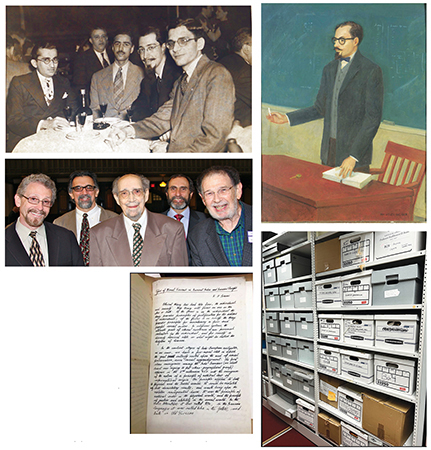
Clockwise from top: Prof Kaikhosrov Irani (2nd from r) with friends at The Greenwich Village Inn; painting of Irani,
The Piece of Chalk by Ben Lassen, 1958; Prof Kaikhosrov D. Irani Archival Collection in The City College of New York Archives
and Special Collection Repository; manuscript page from "Types of Moral Visions in Ancient India and Iranian Thoughts;" Irani
(center) with colleagues on his 90th birthday
Clockwise from above l: Kersi Shroff, Jerry Beersdorf II,
Ruzbeh Hodiwala and Aban Rustomji
While collecting books, manuscripts, literature and scholarly material pertaining to the Zoroastrian faith, history and culture, FIRES (FEZANA Information Research and Education System) also concerns itself with preservation and digitization of damaged manuscripts and lithographs. Founder and co-chair of FIRES, Aban Rustomji elaborated on the digital recording of the oral history project conjointly undertaken by FIRES and the Zoroastrian Association of Houston.
The possibility of presenting globally dispersed Zoroastrian artifacts in a single digital collection was touched upon by Shroff. Also demonstrated was a prototype of a digital platform especially created by Henri d’Orgeval, a French software developer and the creator of digital projects on learning Avesta and the Shahnameh.
The final report on the 12WZC will appear in the August 7-20, 2023 issue of Parsiana.