A little house in Navsari stands tall as a memorial to Jamsetji Tata
Text: Farrokh Jijina Photos: Jasmine D. Driver
The little house in Dasturwad, Navsari wore a spanking new look. Decorated with chalk and toran, the house had heeded the call to "Parsi founded institutions and homesteads…to decorate their premises with flowers, lights and chalk to celebrate the 250th glorious anniversary of the Navsari Atash Behram.” (See "Nurtured in Navsari,” Parsiana, October 21, 2015). When Parsiana visited the birthplace of Jamsetji Tata, founder of the house of Tatas, on October 3, 2015 it was buzzing with Zoroastrians, many of whom had converged there after attending the historic jashan at the Atash Behram.
Walking in through a low wooden doorway, we entered a small sitting area. A garlanded statue of the patriarch greets visitors. It is "modelled from the one that greets visitors to Bombay House,” the headquarters of the conglomerate, explained the genial Freny Shroff, archivist at Tata Central Archives (TCA). Giving visitors an overview, Shroff explained that the 1,500 sq ft house belonged to Tata’s maternal family. As was customary in those days, Jeevanbai, Tata’s mother had come to her father’s house for the birth of her firstborn, she said. This was the house "where the ancestors of the founder had lived for 25 generations as priests.” A four-page folder designed to help visitors through the historic place notes that the house was owned by Kavasji Tata, great-grandfather of J. R. D. Tata and was endowed to the J. N. Tata House (Birthplace) Trust by J. R. D. on March 3, 1939, the centenary year of the founder’s birth. To the right, in the sitting area, a panel depicting the family tree of the House of Tatas enlightens visitors about the descendants of Jamsetji.
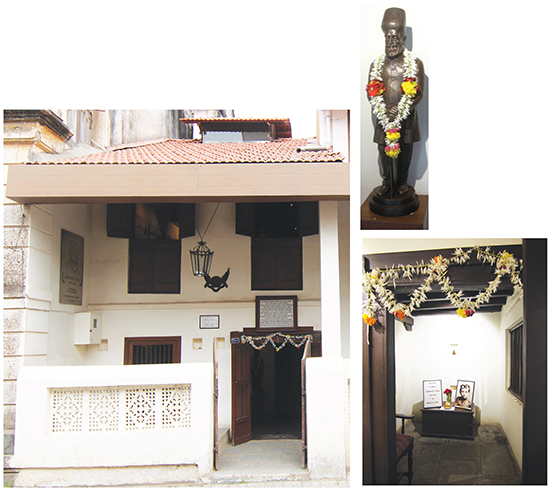
Clockwise from top right: Garlanded statue of the patriarch;
the room where Jamsetji was born; entrance to the house
"Go inside,” urges Shroff, nodding towards the room where the patriarch was born – a spartan place, furnished with a chest of drawers, an armchair and picture of Tata as a child. A bunch of red roses and a divo are the only ornamentation in the room. Adjoining this is a prayer room with utensils that were in use at the time. Another room leads to a rear entrance and a small outdoor area. Passages on the ground floor are lined with panels providing details of Tata’s parents and sisters, and a chronological listing of his significant achievements, in both English and Gujarati.
Also included are panels on the founder’s visits to China, Hong Kong and the UK. "Nothing perhaps was more remarkable about him than his endless thirst for knowledge,” states one panel titled Bapooji, the Little Father, a reference to his being the central father figure at home. A panel titled Trivia elucidates on the visionary’s fondness of food. "Every day he would enjoy food rich in fat and spices with a complete disregard for the limits of human digestion,” it states.
"Now you need to go to the first storey; it houses memorabilia of his favorite passions – power, steel and education,” Shroff says when we are done with the ground floor. "Make in India happened with the Tatas a century ago,” she smiles, tongue-in-cheek, a reference to prime minster Narendra Modi’s exhortation to foreign businessmen to use India as a manufacturing base. A short narrow flight of stairs leads to what could have been the family’s sleeping quarters a century ago. It now houses digitally enhanced photographs of the events surrounding Tata’s vision for magnificent companies and institutions that were to come - Tata Iron and Steel Company (now Tata Steel), Tata Power Company and the Indian Institute of Science. The 12 odd panels tell the story of the founder’s foresight with photographs, quotations and anecdotes from the formative years of the three institutions.
A picture of Jamsetji at the fifth Indian National Congress and a reproduction of his famous letter of September 1898 to Swami Vivekananda "seeking his help in connection with his scheme for a University of Research in India” (which found fruition in the Indian Institute of Science) are shown in a panel titled "With national leaders.”
Shroff is eager to point out: "Did you notice his vision – one of the first recipients of the J. N. Tata Endowment Fund was a Parsi woman gynecologist, Freny K. R. Cama? Did you notice that Empress Mills provided for crèches for children of women workers over a 100 years ago?”
As we leave, we see the words on a plaque in the main sitting area that read, "What advances a nation or a community is not so much to prop up its weakest and most helpless members, as to lift up the best and most gifted, so as to make them of the greatest service to the country.”
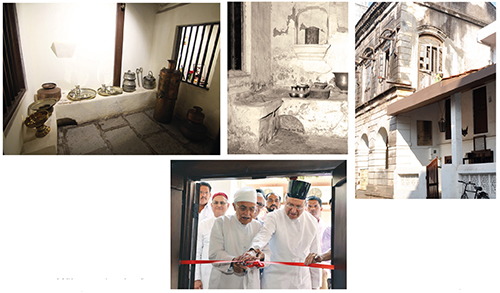
Above, from left: A room in the house; the interiors prior to restoration Photo: Tata Central Archives;
a view of the founder’s paternal home, adjoining his birthplace;
Farrokh Kavarana, former director, Tata Sons and Dastur Kaikhushru N. Dastur Meherjirana
inaugurating the renovated house, March 3, 2014 Photo: Tata Central Archives
Panels on the first floor
Tata Archives
The house in Navsari that pays homage to the founder of the group is a key project of TCA. In response to Parsiana’s follow up questions, Rajendra Narla at TCA confirms that Russi Lala, the late director of the Sir Dorabji Tata Trust who during his association with the Tata group authored a number of books celebrating the Tata heritage, "after years of frustration, raised the matter (of setting up an archive) with J. R. D. Tata, who jumped at the idea. "I always wanted the archives,” J. R. D. said, for when Tata Airlines was nationalized in 1953, Tatas gave up "all the records to the government.” Narla states that TCA was formally inaugurated at its present premises in Poona by the then group chairman, Ratan Tata, in February 2001. Explaining that the TCA collection comprises documents, photographs, paintings, awards, medals, citations and other memorabilia, Narla shares that the number of items has grown from 3,00,000 articles in 2001 to over 15,00,000 today.
 Tehmuras ("Donn”) Doongaji, erstwhile managing director of Tata Metals and Strips Limited which had its manufacturing facilities for cold rolled steel strips in Navsari, recalls his association with the restoration of the property in two emails sent to Parsiana. A frequent visitor to Jamsetji’s birthplace, Doongaji mentions, "It was my long cherished dream that the place should be turned into some kind of a museum.” The people involved in the restoration project were Farokh Subedar, chairman Tata Services, Zubin Mistry, assistant vice president of finance, Tata Services, and Shroff, along with a specially put together team from TCA, he says.
Visualizing that Jamsetji’s birthplace could be turned into a tourist spot that could be visited by many "to tell the story of one of the greatest sons of India,” he was happy to see the dream realized in 2014, when on Jamsetji’s 175th birth anniversary, the little house threw open its doors to the public after extensive restoration that cost Rs 20,00,000 ($ 30,800).
Coordinating with architect Jamshed Bhiwandiwalla, Doongaji assisted in providing the required contractors in Navsari. Forays into "Chor Bazar in Bombay to get some small knick- knacks that could be similar to things of a gone-by era and several visits during the restoration work was my little contribution, more a labor of love than anything else,” he says.
Doongaji mentions that a jashan has always been conducted on the founder’s birthday, March 3, every year in his birthplace in the presence of the trustees and other invitees. The current trustees are Hoshang Malesra, Sarosh Batliwalla, Jal Tata, Sorab Vajifdar and Dr Rohinton Avari.