The Shahnameh’s (SN) many facets were examined by international scholars at the seminar hosted by the K. R. Cama Oriental Institute January 8 and 9, 2011. Parsiana presents synopsis of their papers in six installments beginning with a review of the many celebrations of the epic a thousand years after it was composed (August 7, 2011). Subsequent installments dealt with the Parthian influence and the poet’s concept of evil (August 21, 2011), some of the sub-plots in the poem that spans human memory from prehistory to the fall of the Sasanians (September 7, 2011) and conflicting perceptions of Alexander (September 21, 2011). The art and illustrations that the epic spawned are discussed in this issue. The concluding installment will deal with the treatment of some of its themes from different perspectives, different cultures and why an epic is an epic.
Dr Imtiaz Ahmad, director of the Khuda Bakhsh Oriental Public Library at Patna spoke about the rare and elaborate Arabic and Persian manuscripts in the Library collected not only from all parts of India but from Egypt, Turkey, Arabia and Syria as well. Catalogued in 43 volumes in English, printed as well as on the Library’s website, it is a work in progress. Now holding 28 manuscript copies of the SN, Ahmad praised the documentation undertaken by the Shahnama Project with its wide range of information on manuscripts preserved all over the world, mentioning 92 copies of the SN at 26 repositories in India.
Classified into five categories — ornamental illustrated; simple illustrated, calligraphic specimens; abstracts and pictorial albums — Ahmad described one bearing catalogue number 2: "Its 538 folios have 24 lines each, written in four columns with one gold and two ornamental rules. It contains 51,000 verses and 27 illustrations with light gold forest-scene ornamented borders. It is decorated with two richly gilt, colored and sumptuously designed full page decorations. The beginning of the Preface is written in gold on a blue background with floral decorations… The headings are ornamental throughout… and the manuscript is preserved in its original binding.” Mahatma Gandhi is said to have noted in Young India that the SN is a veritable feast for the eyes, stated Ahmad. His many descriptions of the gems in his collection beggared the imagination.
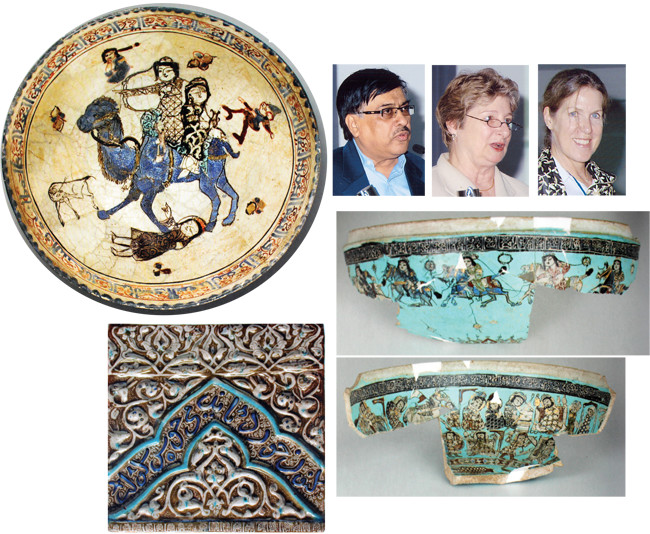
(Clockwise) Drs Imtiaz Ahmad, Marianna Simpson and Olga Davidson; Fragmentary bowl with scenes from the story of Faridun, a frieze from Takht-e Suleyman and bowl with Bahramgur and Azadeh (Courtesy: Epic of the Persian Kings, K. R. Cama Oriental Institute)
This Library had its beginnings in the first half of the 18th century as a personal collection of 1,400 manuscripts developed by Moulvi Muhammad Bakhsh, a zamindar of small means in North Bihar who settled in Patna. It was then known as Kutubkhana-I Muhammadia. Prior to his death in 1876, he handed over these manuscripts to his eldest son Khuda Bakhsh, instructing him to enrich the collection and convert it into a public library. Khuda Bakhsh raised the number of manuscripts to 4,000 and set up a public library through a formal trust deed on January 14, 1891. Named Bankipur Oriental Library it was formally inaugurated by the Governor of Bengal, Sir Charles Elliot.
Artistic engagement
Dr Marianna Shreve Simpson, an independent scholar who has taught and lectured widely on Islamic art, referred to preoccupation with the starting date for the tradition of illustrating Ferdowsi’s SN in manuscript form and noted that "the narrative images related to stories found in the Persian Book of Kings were being produced several centuries before Ferdowsi set to work on his great epic poem and that this artistic engagement with epic kings, heroes and villains such as Rustom, Bahram Gur and Azadeh (a villain-ess!) continued — with seemingly greater frequency — during later medieval times.”
Concentrating on the impact of the poem on the visual arts of Iran during the 12th and 13th centuries, and some of the evidence that has survived, she noted that "SN verses and probably also SN images adorned the inside of Persian palaces, particularly throne and banqueting halls. She cited a rare fresco belonging to the Harvard Art Museums depicting two scenes from the SN. "The fresco’s upper register remains enigmatic, but the lower one clearly represent the SN king Faridun mounted on Barmiyeh, the cow that nurtured him as a child, and leading the captured tyrant Zahak to Mt Demavand… The figure in front is the blacksmith Kava who assisted Faridun in his overthrow of Zahak and in reclaiming the Iranian throne.” Simpson goes on to say that the scene does not correspond to the Faridun and Zahak story as recounted in the SN but seems to be composed of various portrait like units assembled into a group symbolizing a story familiar to us from the SN.
Simpson laid particular emphasis on a star shaped tile (now in the US) identified as coming from the palace complex of Takht-e Suleyman, a summer residence in north west Iran built circa 1270 which was known to have SN verses and illustrations covering its walls. She also noted that these halls with SN frescos were sites where live performances of the epic dastans, like the stories of Forud, Rustom, Bizan and others took place. Some such illustrations also featured on pottery. She cited "the Freer Beaker” painted in a particular style with great artistic verve depicting 12 incidents of the Bizan-Manize story in three tiers. She has suggested it was meant to simulate the bowl which revealed to Kai Khosrau on Nawruz day where Bizan lay trapped and captive and that the beaker was probably used only on such ceremonial occasions in later days. She envisaged a "a sort of medieval son et lumière” against the background of the Takht-e Suleyman walls as the scenes were enacted on special occasions.
It is unlikely that the entire contents of the SN were reproduced on the walls of the palace. "What the palace décor contained instead were verse selections from cycles belonging to the three main eras — mythical, legendary and historical… So while the individual tile inscriptions were abbreviated and even uneventful, when installed side by side within a frieze at Takh-e Suleyman, they filled its spaces with the full scope and continuum of Ferdowsi’s epic poem.”
She observes that this palace is a "continuation — not the initiation — of a well-established visual narrative tradition.” She also notes that basically two items from the grand scheme of the SN have been produced and reproduced visually in extra-textual settings — Faridun and Zahak and Bahram Gur and Azadeh — to the exclusion of other events and we need more research to be able to answer why.
Citing the work of Simpson and others, Dr Olga Merck Davidson, a research fellow at the Boston University’s Institute for the Study of Muslim Societies and Civilizations, spoke of the collaborative relationship between scribe and painter in producing illustrated versions of the SN: the scribe copied out the text by hearing it dictated to him, while the painter illustrated relevant thematic scenes. Presenting a paper on "Interweavings of book and performance in the making of the SN,” she argues that oral traditions that shaped the composition of the SN are interwoven with the concept of an authoritative book as the basis for the performance of any part of the SN narrative. Referring to an earlier work of her own, Davidson stresses "the idea that a prose Book of Kings is the authority for the oral traditions about the deeds of these kings and other deeds is part of an overall etiology (cause and effect) embedded in the oral traditions of the Persianate song culture.”
She quotes from the preface of the Baysonghori SN (a later publication with substantial addition to the original): "When it came to Yazdegerd’s reign, all those historical accounts had been preserved in his library but in no particular order. He ordered Daneshvar, the Dehqan — a senior figure at the royal court who combined courage with learning and wisdom — to organize a list of chapters and arrange them in order from the beginning of the rule of Kayomarth to the end of the reign of Khosrow Parviz. And whatever lacunae he found there he filled and appended by asking information from the learned and the Zoroastrian mobads. And so a chronicle of sheer perfection and comprehensiveness was created.”
To this Davidson adds, "the turning of this prose text into verse was the genesis of the oral tradition.” Simultaneously proceeding, however, was "a never ending search for more versions of such a book, stemming from the various different regions of the Persianate song culture — a search to accommodate as many different versions as possible in a quest to contain the sum total of the SN of Ferdowsi.” To be continued