The fourth oldest fire temple in Bombay has been spruced up
Text: Farrokh Jijina Photos: Homyar Mistry — Homz
Walking over the potholed Dr Dadabhai Naoroji Road pavement, past the rat-a-tat of drilling for the proposed Metro line, one ascends the short flight of marble steps to the front verandah of the Dadysett Agiary. A spacious hall with floor tiles agleam, wooden benches and large, newly polished portrait frames greet the visitors to the recently renovated premises. After about three months, the trustees of the fire temple unveiled the renovated interiors with a jashan on June 9, 2023.
"The costs were substantial but a large portion of the expenses were born by a single donation,” stated trustee Behram Ardeshir to Parsiana on June 15.
"We regularly do a physical inspection of all our premises internally and externally and also regularly have a structural inspection done... During the course of one such physical inspection earlier this year, we noticed that the wooden rafters in the ceiling were sagging. Upon a closer examination we found that many of the very old wooden beams were actually rotten and liable to give way. This presented a serious problem and required to be addressed immediately. Fortunately there was no sign of termites,” said Ardeshir. Stating that the trustees did not wish to "spoil the ambience by putting metal sections as is the wont today, we spent some time procuring suitable old teakwood beams and then began the work.” The hall of the Agiary was plastered and painted, the wiring was completely redone and whichever wood beams needed to be replaced, were replaced. The main fire was moved to the dadgah room while renovations were on.
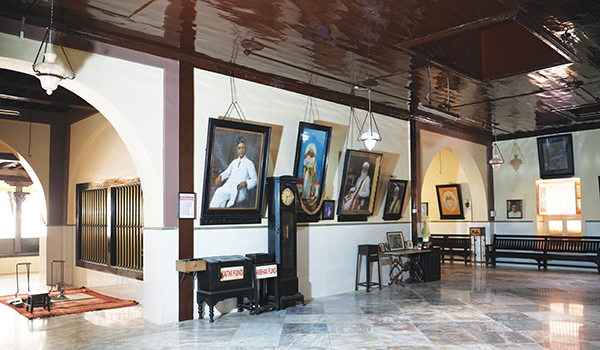
Clockwise from top: entrance to Dadysett Agiary and front verandah;
ventilation; rear verandah; decorative bracket and clock; well
Armin Kermani, who works for Dadysett Charity Trust (DCT) that runs both the Agiary and the Dadysett Atash Behram about three kilometers away, points out the wooden beams that are newly replaced and painted.
The Agiary has three full-time mobeds on their payroll "and one more mobed practices here… We do not follow a panthaky system… All mobeds are employed by us... they take it in turns to do the boi and are all equal,” said the trustee.
Ardeshir said it is difficult to estimate the number of footfalls at the Agiary. "We do not monitor the daily footfalls as some devotees may consider it to be mildly invasive… We have always had a fairly decent footfall with regular devotees both pre and post Covid.” When Parsiana visited, a few hours before the afternoon jashan was to be held, there was one worshipper. Workers were giving finishing touches to the cleaning tasks before the ceremony under Kermani’s supervision.
The Agiary structure, a one-storied building with little external embellishment, dates to 1803. The fire was first consecrated in a building diagonally across from the current building, Ardeshir told us. China trader Dadybhai Nusserwanji (1734-1799) commonly known as Dadysett, "also erected on the south side of Todd Street (today’s Ghoga Street) a second fire temple (after the 1783 consecrated Dadysett Atash Behram), wrote Parsee Prakash editor Rustum Paymaster in A Short History of The Dadysett Religious and Charitable Trusts with the Scheme for Their Management Sanctioned by the High Court. "After the death of Dadysett…the sacred fire was removed by his son Ardeshir Dady in the year 1803 to a new building erected by him…on the east side of Hornby Road in the immediate vicinity of the said agiary in Todd Street, and known by the name of Dadysett’s Agiary, for the purpose of celebration and divine worship according to the customs of the Parsis (see "Dadysetts’ dedication” Parsiana, July 21, 2019).”
The Fort, which includes areas around the Agiary once had a sizeable Parsi population, now much shrunk, on account of families moving away to the suburbs. "I would rather have the worshippers distributed between the (six) agiaries of the Fort (Langdana, Godavara, Maneckji Sett, Vatcha and Banaji Limji — the oldest surviving agiary in Bombay)… Others may not have the resources we have...
"Trustees can do very little to improve the footfall and we definitely have to think of the rising costs, especially since donations are also reducing,” said Ardeshir.
The Agiary conducts two muktads annually, both Kadmi and Shahenshahi.
"The attendance in 2022 was definitely less than pre Covid and hopefully it will improve this year,” said Ardeshir. Kermani told Parsiana that there are 45 tables in this year’s Kadmi muktad that began on July 7th. "Fortunately we have very dedicated clergy.”
Ardeshir names deft handling of social media as one of the key challenges for himself, and indeed for any fire temple trustee. He cited an attack on social media when renovations were progressing in the kathi room of the DadysettAtash Behram. Traditionalists objected to the use of non-Parsi workmen conducting the repairs. "I asked him (Yezdi Hodiwalla, who spearheaded the attack) to meet me and talk about it, rather than object from the comfort of his keyboard… Please come with practical suggestions… Let me see what they (the activists) do.
"There are so many statutory compliances required that in addition to our regular work we have to educate ourselves and ensure that we meet these compliances… The exorbitant rise of property tax is an area of concern. It’s a role and responsibility each trustee accepts when he or she becomes a trustee so there’s really no option but to execute our duties to the best of our abilities.”
Besides Ardeshir, the other trustees at DCT are Vera Choksey, Mahernosh Humranwala, Shapoor Mistry and Xerxes Master. Ervad Darayesh Katrak serves as the secretary of the Trust. Aged 60, Ardeshir stated that he is looking forward to handing over the day-to-day management to a younger trustee. "We have to have a seamless transition… planning for that is on… My job is to ensure today that DCT is financially independent for the next 100 years.”
The keepers of the kathi
When social media was recently rife with news about non-Parsi workers carrying out renovations in the Dadysett Atash Behram kathi room (where logs of firewood used to keep the fire burning) H. B. Wadiaji Atash Behram High Priest Dastur (Dr) Firoze Kotwal wrote an open letter to "activist” and Parsee Voice co-editor Hanoz Mistry stating, "Once an atash behram, adaran or dadgah saheb is built, every part of the building is considered to be sacred… After the atash behram is consecrated, the whole edifice is regarded as sacred and pure, i.e. the sanctum sanctorum, the ijeshne gāh or urwis gāh, and its pāwis, where (higher) rituals such as the ijeshne, bāj, vendidād will take place, are all consecrated because a number of ijeshne and bāj are done in its precinct. The prayer hall attached to the sanctum, where worshippers stand before the fire, the main outer hall where jashans are performed, the kathi room or any room or place within the footprint of the atash bahram building are all considered to be consecrated and hence sacred…Non-Zoroastrians are not allowed within the fire temple structure. In case repairs need to be done, then the sacred fire is shifted at night with due ritual precaution to a room or hall that is not physically connected to the atash behram building in any way… If repair work is required to be done, our community has a number of volunteers dedicated to repairing our religious places of worship, and they should always be used.”
Kotwal stated that he has asked Ervad Hormuz Dadachanji, panthaky of Vatchagandhy and Mithaiwala Agiaries to find out about the issue and "to send out a firm message to those in whom Ahura Mazda has entrusted the sacred duty of being the guardians of our sacred and revered fire to ensure that such violations do not happen in our pak atash bahram makan (building) anywhere in India.”
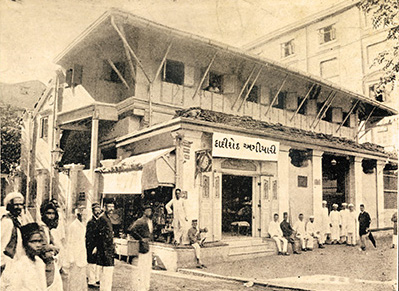
Vintage view of the Dadysett Agiary
Speaking to Parsiana on June 30, Dadachanji told us that Katrak had agreed that they will store the kathi at the place not physically connected to the Atash Behram. Ardeshir told Parsiana on July 3 that they have located a temporary space to hold kathi, away from the main building.
In reality, all over India in many fire temples, non-Parsi personnel are used for sweeping and swabbing the floors, changing tube lights, replacing washers, etc. The kebla doors are kept closed when they are present. As priests and assistants age, it is not practical for them to attend to the physical needs of the structure.