If the late Ratanji Tata had not fallen in love with a Parisian beauty in 1902, the trustees of the Bombay Parsi Punchayet (BPP) would have been selected, not elected. However, in 1908, in the celebrated case of Petit vs Jeejeebhoy (more known for the conversion of a French woman to Zoroastrianism), the Bombay High Court held that the then BPP trustees were not validly elected (see "The French Revolution - II,” Parsiana, May 7-20, 2022).
The High Court went on to frame a Scheme of Election for the trustees on June 18, 1910. This Scheme was amended in 1931, 1935, 1970, 1991, 1992 (twice), 1993, 2005 and 2006. In 2007, the Scheme was radically overhauled to introduce universal adult franchise; and an entirely new Scheme was introduced over four months ago on March 1, 2022.
The principle underlying schemes prior to 2007 was that the leaders of the community be elected by a small group of wise elders. Those, in turn, would be elected by the entire community. Thus, all had a say prior to 2007, albeit indirectly. This group of wise elders was originally restricted to 100, Sau-nu-Mandal, officially termed the Anjuman Committee (AC). From 100, the AC proliferated over the decades to a few thousand.
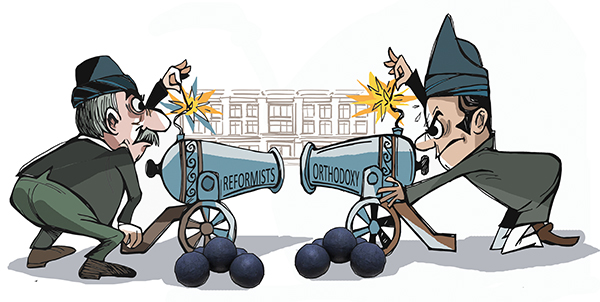
Illustration by Farzana Cooper
Elections were rather boring affairs then. Every 10 years (sometimes even later) when the Sau-nu-Mandal was elected, few Parsis were aware and fewer bothered to vote. This elector body was therefore of a conservative hue, to say the least.
In 1822, after publishing a booklet to reform the BPP, Sir Jamsetji Jejeebhoy became a trustee. Lady Navajbai Tata a true philanthropist, who had adopted Naval Tata, became the first woman trustee in 1939 and remained in office till 1946. Navajbai supervised the feasts for Parsi girls in Navsari’s free Tata School and was terribly upset with an organizer who scolded a girl for taking food home for her widowed mother; thereafter she would personally stuff English confectionery into the pockets of the girls. In the 1950s and 1960s, Lady Hirabai Jehangir ruled the roost. Perhaps she was the last of the aristocratic trustees. She was not as universally adored as Tata.
From the 1960s, the trusteeship elections were often fought between old adversaries. The term of office was 10 years and there were no term limits. Gerontocracy prevailed. A founding partner of a leading firm of chartered accountants, Kalyaniwalla and Mistry, Maneck Mistry, skirmished with another from his profession, one Pestonji C. Hansotia. However, no allegations were hurled, and never was the line of decency crossed.
Then in the late 1960s, things hotted up. An aristocrat bearing a famous surname was a leading favorite to win that Saturday, the day on which trusteeship elections were always held at the BPP office located next to the Handloom House (everyone happily went home after the results were declared by 7.30 p.m.). Members of the Sau-nu-Mandal were aghast or amused (depending upon their predilection) to receive an anonymous, cyclostyled letter in Gujarati by post on Thursday morning referring to the widely known and almost public affair of the aristocrat with a married lady and questioning how one could trust a person who had breached the trust of his wife. The gentleman lost to the mercurial solicitor Shiavax Vakil, a larger than life figure. Vakil was a devotee of a Sufi guru. Later, he entered the dakhmas with his trustee colleague, the famed cardiologist Dr Aspi Golwalla, to assess the true state of affairs. He was relentlessly attacked by the orthodox, even with physical threats. General counsel for the Tatas, Vakil thought it prudent to divert his energies to more fruitful pursuits and resigned mid-term on condition that the genial and charming industrialist Jamshed Guzder, who did immense personal charity for Parsis, wore colorful silk shirts and himself drove his red Mercedes till his mid-80s, was elected in his place.
After serving a term, Guzder stepped down in favor of the soft-spoken industrialist Naoroji Godrej. Guzder was subsequently reelected and, claiming seniority, sought to be chairman. Unhappy with the hurly burly of Parsi politics, Godrej, like Vakil, decided to depart after a short stint. Trustee Eruch Desai, a solicitor, objected to Guzder’s claim saying that he had unbroken seniority. Desai decided to move the Bombay High Court. This was amongst the few times that matters went from the BPP board room to the courts. After a hearing or two, a compromise was reached between the dour Desai, who was always conscious that he was an akabar, and Guzder.
For B. K. Boman-Behram, a career politician in the municipal corporation, winning trustee elections was child’s play. He religiously feted his supporters after an election victory at the Ripon Club where he invariably served fish fillet with tartar sauce and had name plates for his guests so that couples would not sit together but were forced to mingle.
The Committee for Electoral Rights (CER), a self-styled ginger group, became somewhat complacent due to the near 99% majority it enjoyed in the general register of the AC (having successfully managed to get its leaders Jamsheed Kanga and Minoo Shroff elected) and decided to field the irrepressible Fali Poncha as a candidate, believing it would be a walkover. However, an odd combination of support from the Godrej group (miffed with the CER siding with their bête noire, Guzder, on various issues) and the orthodox (smarting at their decimation in the AC elections in 1981) put up a young tax lawyer, Homi Ranina, nephew of the legendary lawyer Nani Palkhivala, against Poncha. The newsletter of the CER, The Zoroastrian claimed the tax free BPP did not require a tax expert, but homeless Parsis required a home builder (Poncha was managing director of Tata Housing). Just when everyone thought Poncha would sail through, the Donor Register of the AC received a spate of donations of Rs 5,000 each, and swelled in size. Then Poncha made things difficult for himself by making a very long-winded speech, in US presidential style public debate at the Birla Matushri Hall (where Vakil was the moderator) as compared to the crisp and logical arguments of the underdog Ranina. Poncha scored several self-goals in this debate and was often cut short by the stern moderator. Ranina won the election comfortably. He, much to the surprise of many, never stood for reelection. Subsequently, the CER managed to get all its other leaders like Dinshaw Mehta, Dadi Engineer and Silloo Kavarana elected as BPP trustees with consummate ease. Ranina was the only one who flew over the cuckoo’s nest. Poncha, though very active in Parsi politics, never stood for another election.
Berjis Desai, lawyer and author of Oh! Those Parsis, and recently Towers of Silence, is a chronicler of the community.