Finding meaning, messes
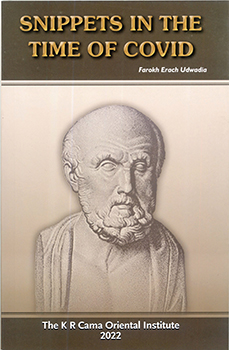
Snippets in the Time of Covid by Farokh Erach Udwadia. Published in 2022 by The K. R. Cama Oriental Institute, 136, Bombay Samachar Marg, opposite Lion Gate, Fort, Bombay 400023. Pp: 104. Price: Rs 1,000.
Our collective experience of the macabre pandemic we went through recently was diverse. For some, Covid was brutal. For others it was freedom from social and professional commitments. Some found meaning in it; others felt it was a mess.
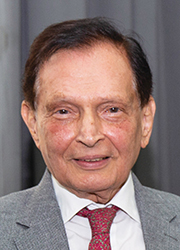 The digital world rose to the occasion, with the medical fraternity conducting some of their activities on a screen. Prior to Covid, Dr Farokh Udwadia (pictured), one of the country’s most eminent and revered physicians, conducted clinical meetings on Fridays at the Breach Candy Hospital. These were enthusiastically attended by his colleagues, students and staff of the Hospital. During the pandemic, as he was not permitted to visit the Hospital on account of his age, he kept in touch with his colleagues through weekly online clinical meetings. After each medical discussion he would give a short talk on subjects that he said kept him youthful past the age of 90. He would enliven his colleagues and staff with anecdotes from history, medicine, art, literature and poetry. These enriching stories transcribed to text became the genesis of his 104-page book Snippets in the Time of Covid published by The K. R. Cama Oriental Institute.
The fragments of information shared in each of the 15 snippets simultaneously captivate the common man and mesmerize the medical professional. Enchanting insights into history and culture made me want to read Udwadia’s book all at one go. On occasion, he details dates and figures with such exactness that it leaves one spellbound.
In the first snippet, he speaks of the Spanish Flu of 1918-1919, which was reported to have decimated close to 100 million people globally. I was intrigued to learn that it did not start in Spain. The story of how and where it started, how it was mismanaged by overdosing patients with aspirin, and what led to its spread in an era where there was no air travel was compelling. Similarly, he shares stories of the 14th century plague in Europe called The Black Death and how people at the time thought it was a kind of divine retribution against man’s sins.
In a few other tales, Udwadia takes readers on a journey across the practice of medicine in ancient Egypt and Greece, explaining how major civilizations started on the banks of great rivers. We learn how the Egyptians, who firmly believed in an afterlife, mummified their bodies, how gods were central to healing in their culture and how Egyptians practised subspecialty medicine 5,000 years ago.
 He narrates how the word ‘marathon’ originated after the Olympic Games in Greece in 776 BC named after the Battle of Marathon, where the Greeks defeated the Persians. A soldier was told to run as fast as he could to give the good news to the Athenians. He ran to Athens as fast as he could, announcing "Athens has won!” and then dropped dead.
Faith heals everything, believes the doctor. We see that time and again even in the modern practice of scientific medicine. There were places of healing built in 750 BC in Greece, where patients were miraculously cured of their ailments after ritual bathing. Even Dr William Osler, one of the greatest physicians of the 20th century, said, "Nothing in life is more wonderful than faith — the one great moving force which we can neither weigh in the balance nor test in the crucible.” There is an entire chapter in the book dedicated to Osler, whose life and times enamor the reader. While some of the chapters in the book start with enthralling information, others end with soul touching poetry.
As a pioneer of eradicating infectious diseases, Udwadia dedicates a snippet of how infections were controlled by certain great individuals, whom he fondly calls ‘microbe hunters.’ He narrates how something as mundane as washing one’s hands to help prevent infection was such a mysterious discovery in that time, and how Louis Pasteur, French chemist and microbiologist stated, "In the fields of observation, chance favors only the prepared mind.” Pasteur was the first one to suggest boiling milk to rid it off its infection — and that is how we have pasteurized milk, named after him. He was the one who made vaccines for anthrax and rabies, and it was at the Pasteur Institute in Paris that the Human Immunodeficiency Virus (HIV) was discovered. In another chapter, we learn how Scottish physician Alexander Fleming discovered penicillin by chance, which changed medicine forever.
Udwadia relates how anesthesia was serendipitously discovered, a finding that revolutionized the practice of medicine. He also speaks about how English social reformer Florence Nightingale, the Lady with the Lamp, transformed the art of nursing and patient care. In further snippets, we learn about the heroes of American medicine, Dr William Beaumont in particular, who treated a patient with an open abdominal wound for two decades, studying the physiology of the stomach and giving the world the field of gastroenterology.
Just like Covid exemplified stark contrasts, Udwadia ends the book with two antitheses: war and music. While one destroys mankind, the other heals. As one ravages civilizations, the other restores humanity, and in the famous words of the English poet Percy Bysshe Shelley, he reminds us, "If Winter comes, can Spring be far behind?”
Dr MAZDA TUREL
Turel is a practicing neurosurgeon, Wockhardt Hospitals and honorary assistant professor of neurosurgery, Grant Medical College and Sir J. J. Group of Hospitals.