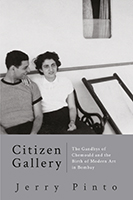
Citizen Gallery: The Gandhys of Chemould and the Birth of Modern Art in Bombay by Jerry Pinto. Published in 2022 by Speaking Tiger Books LLP, 125-A, ground floor, Shahpur Jat, New Delhi 110049; website: www.speakingtigerbooks.com. Pp: 317. Price: Rs 899.
He’s termed the book the Kekoonama. Whether author Jerry Pinto fancies himself a Firdausi might be open to question. He has however created a portmanteau portrait of the life and times of old Bombay’s favorite art dealers and framers, Khorshed and Kekoo Gandhy and spun them into a myth of his own making.
Towards the end of the book, there are sections where the voices or words of the Gandhys, interviews with them and old reviews have been reproduced with minor editorial intervention. In one such paragraph, Kekoo describes what happened during their first M. F. Husain show at their shop-cum-gallery.
"I looked out of the window and saw my wife’s uncle, the founder-owner of Parsiana magazine (Dr Pesi Warden), passing by. I just pulled him in and said we needed a crowd. The poor man had no idea what was going on. But Husain sold so well that we were flooded with work from artists all over India.” It would not be wrong to admit the reader is often left feeling like that uncle.
It is a Eureka moment. Modern Indian art has just been birthed in Bombay as promised in the subtitle. Pinto however is so busy staring out of his window pulling all manner of thoughts, ideas, artists, art lovers, critics and consumers into his hold-all, the reader tends to feel totally bemused. It is at times as enchanting as one can expect of the author’s commitment to the protagonists. At other times, filled with all manner of deviations and repetitions that have more to do with Pinto’s own fascination with personalities of the Parsi community, than anything pertinent to the subject.
Just to mention one instance, Pinto appears not to resist the lure of stories about Bapsy Sabavala, the grande dame of Bombay society in the years between the wars. That she had a fondness for animals, including a pig who was a household pet, had a collection of dolls that she treated with a devotion usually reserved for children cannot be denied, but she was also famous as a hostess. She threw her mansion open to the literati and chatterati of her time. One thinks of just two of them Ram Gopal: the dancer and John Gielgud, the famous Shakespearean actor who, like the English of the time, left a wry account of the evening. She was also well known for her philanthropy and plain speaking. Why she should be portrayed with one of her dolls in hand and her eccentricities given so much importance is somewhat incomprehensible. Let us also breathlessly add that the photographs, however badly reproduced in the book, are also part of the fascination that the volume has for both art lovers and celebrity seekers.
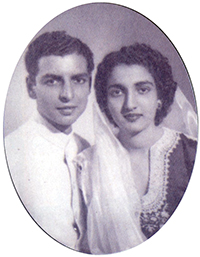
Kekoo and Khorshed Gandhy
Center: Kekoo Gandhy with art collectors
Kali Pundole (l) and Jehangir Nicholson;
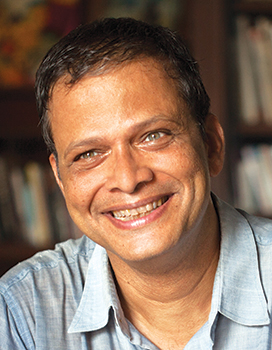
below: author Jerry Pinto Photo: Ashima Narain
Pinto in his Firdausi mode hares off in different directions chasing long forgotten friends, associates and possible art collectors who wandered into the Chemould Gallery creating a diaspora of the Gandhys’ artistic fraternity. It would be a little facile to ascribe part of the Gandhy couple’s influence as extending for a large part due to the existing Parsi network in the city’s upper echelons of power. Khorshed belonged to the illustrious Adenwala family. The ease in which Kekoo segued, from the different levels of society of Bombay, not to mention in New Delhi where a whole new set of power play had emerged post-Independence, or Calcutta still clinging tenaciously to its privileged albeit truncated past, marks an interesting social paradigm. It might even explain why Bapsy still had a place at the ball, even if the orchestra had stopped playing her song.
It may also underline the vignette provided by Rajmohan Gandhi in the brief but illuminating Preface wherein he describes his association with the Gandhys and their joint membership in the Moral Re-Armament or MRA that had its headquarters in an idyllic village named Caux near Montreux in Switzerland. It began as a response to the horrors of World War II by an American minister named Frank Buchman as a non-denominational awakening of the individual through a process of self-determination and questioning within a collective of aspirants. One of their tenets was that "the seeds of war lie first and foremost in the hearts of men.” The Indian chapter of the MRA was established at Panchgani. Kekoo and Khorshed were probably among the first Indians to travel to Caux. They in turn influenced others to join the fledgling MRA. It later changed its name to Initiatives for Change.
As Rajmohan Gandhi writes in his Preface: "A major memory for me is of a visit that Kekoo and I and the famous (music group the) Colwell Brothers — Steve, Paul and Ralph, very young at the time — made to Vinoba Bhave in a village in the Maharashtra hinterland in the late 1950s when he was collecting land for the landless. I think much of the initiative for this visit came from Kekoo.”
In conclusion he observes: "India and Bombay can also do with a few more like Kekoo and Khorshed. Not easily found. Tradition, charm, art, love of country, love of people, a background of privilege and a lifetime of thought for others. What a combination. I was lucky to be among their friends.”
Pinto’s account allows the reader to enter this multiverse of complex affiliations almost as if he were a time traveler recording events as they happen. The MRA was only one of the experiments with spiritual awakenings that Kekoo followed at different points in their lives. These are also recorded in the narrative. Kekoo encouraged artists with what was for the mid-20th century and later, dangerously subversive views. Pinto includes those that made the cut, into what would become the avant garde. He meticulously records Khorshed’s own feisty battles against the Emergency followed by the regressive communal politics that were darkening the fringes of the once apparently cosmopolitan image of the city.
One can only reproduce the changes that took place under their watch in Pinto’s own description:
"Through the tumultuous decades, Khorshed and Kekoo began to see the fruits of their labor come into being. They had grandchildren across the globe. The gallery had moved out of the Jehangir Art Gallery and had morphed into Chemould Prescott Road. Indian art was selling well, with almost every auction bringing news of a fresh peak scaled; and many of these paintings they probably knew, by artists they probably had nurtured in one way or another. The National Gallery of Modern Art was finally settled into the beautiful and eccentric building across the road from the Chhatrapati Shivaji Maharaj Vastu Sangrahalaya, once known as the Prince of Wales Museum.”
Or as he concludes in the same chapter: "Khorshed was the backbone of the gallery; Kekoo was its wings. Their life together was the stuff of which legends are made; only they were legends themselves.”
By the end of the account, one can only say that Pinto has created what must be called a Kekoo-Khorshednama for all times.
GEETA DOCTOR
Doctor, a longtime contributor to Parsiana, is a writer and critic.