SOLI SORABJEE: Life and Times: An Authorized Biography by Abhinav Chandrachud. Published in 2022 by Penguin Random House India Pvt Ltd, 4th Floor, Capital Tower 1, M. G. Rd, Gurgaon, 122002; website: www.penguin.co.in. Pp: 280. Price: Rs 799.
Soli Sorabjee led a long life which was eventful enough to merit a highly readable biography. Although he never got around to writing his memoirs, a number of festschrift-style books were published during his lifetime which provided windows to his professional achievements. And now comes an "authorized” biography which purports to describe his "life and times,” authored by a practicing lawyer from Bombay who is clearly full of admiration for his subject.
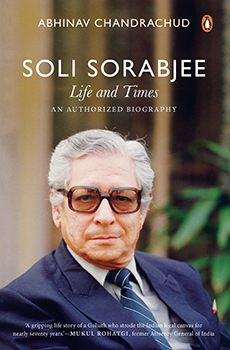
The book could, hints author Abhinav Chandrachud, have very well become Sorabjee’s autobiography:
"On a warm summer day in May 2018, I met Soli Sorabjee (1930-2021) at his residence at Niti Bagh in New Delhi to ask him ... questions about his life. I was there to convince him to write his autobiography. Equipped with my cell phone, on which I recorded six to seven hours of my conversations with him (with his permission), I had hoped to put together a preliminary draft of an autobiography for Sorabjee which he could then build upon, edit and publish.”
But that was not to be because, among other things, Sorabjee’s health was beginning to fail. Particularly fatal to Chandrachud’s plans was the reality that there was a marked deterioration in Sorabjee’s capacity to recall events, especially in the recent past. "This book is, therefore, a modest replacement for the autobiography that never was,” notes the author, resignedly.
It is a relatively short book — no more than 170 pages of text, accompanied by nearly 100 pages of notes, acknowledgements, a back index and excerpts from Sorabjee’s favorite poems and quotes. The last mentioned section, occupying some 13 pages, is of debatable value; many would consider it little more than "padding.”
There are interesting vignettes from Sorabjee’s life, including his early years (his parents, Khorshed and Jehangir, feared that he would convert to Catholicism after finding that religion attractive while in school), his accidental introduction to jazz music (which became a prominent and abiding passion for the rest of his life), the impact that his father’s sudden death had on him (it led to, among other things, a decision to pursue law as a career rather than accountancy which his mother wanted him to embrace), his ascent through the ranks of the Bombay Bar (after being apprenticed under Kharshedji Bhabha, an eccentric and colorful senior lawyer who had initially refused to take Sorabjee under his wings despite being a relative by marriage), and his eventual emergence as a legal luminary who enjoyed high visibility in the public eye not only for the important cases in which he appeared but for his writings, speeches and international activities.
Irritatingly, however, the author’s obsession with statistics — which are strewn liberally and indiscriminately throughout the text — detract from the worth of the book. How many readers would be interested in knowing, for example, that in the year "immediately following the year in which he got his new chamber (sic), (Sorabjee) had 14 reported judgments to his credit?” Or that around 29% of the 87% of his reported cases between April 1977 and January 1980 — when Sorabjee moved his practice from Bombay to the Supreme Court after becoming Additional Solicitor General of India — were "decided by Benches consisting of five judges or more?”
Top: Khorshed and Jehangir Sorabjee; above: Soli and Zena Sorabjee with
children (l to r) Jehangir, Hormazd, Jamshed and Zia
Above: Sorabjee receiving the Padma Vibhushan from President K. R. Narayanan in 2002;
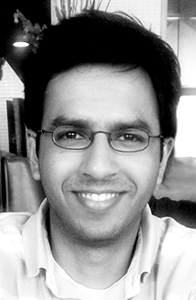
below: author Abhinav Chandrachud
It gets worse when Chandrachud moves on to discuss Sorabjee’s "win-loss” record during this period — a fatuous exercise at the best of times. "In his private practice days, Sorabjee ... won around half the cases he appeared in, perhaps more. Now he won approximately 70% of the cases that he appeared in.” And pray why?
This does not, of course, mean that Sorabjee’s advocacy skills had drastically improved in his years as a law officer. His win-loss record as a government advocate probably tells us something about the nature of our legal system. Among various possible explanations, it perhaps suggests that courts usually show a great deal of deference to governments that come before it (sic). Sorabjee won more cases as a government lawyer than he did as a private lawyer.
The circularity and clumsiness of the prose aside, passages such as these — which abound in the volume — make for painful reading. Many readers will also be struck by the lengths to which the author goes in showing up his late grandfather, Y. V. Chandrachud, a former Chief Justice of India, as a Mr Valiant-for-Justice-and-Courage during the years of the Janata Government despite the self-same judge having, at the height of the dubious state of emergency proclaimed by then Prime Minister Indira Gandhi to save her skin, extolled the virtues of the repressive state and chided certain courageous high courts for showing a "facile distrust of executive declarations which recite threat to the security of the country, particularly by internal disturbance.”
Perhaps the biggest disappointment of all about this book is that it fails to present a rounded view of its subject. That is hardly surprising because there are serious limits to how far an "authorized” biography can go. More is the pity because, as many who knew him will argue, Soli Sorabjee, a champion of free speech and transparency ("sunlight,” he would often say, quoting a cliched phrase, "is the best disinfectant”) deserved a more thorough appraisal of his action-filled life.
VENKAT IYER
Iyer is a UK-based barrister and legal academic.