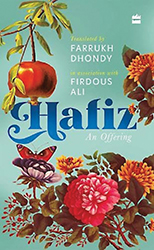
Hafiz: An Offering translated by Farrukh Dhondy in association with Firdous Ali. First published in English in India by Harper Perennial 2023, an imprint of HarperCollins Publishers, 4th Floor, Tower A, Building No. 10, DLF Cyber City, DLF Phase II. Gurgaon, Haryana 122002. Pp: 145. Price: Rs 399.
There have been several translations of Hafiz’s poems since the first attempt undertaken by William Jones in 1772. What is unique about Farrukh Dhondy’s book Hafiz: An Offering is, as he mentions in the Introduction, his attempt "to reproduce the intention of Hafiz’s lines in rhyme and, as far as feasible, the rhythm he adopted.” For this purpose, he collaborated with Firdous Ali who explained the text and gave him a literal translation which Dhondy rendered into poetic form. Ali, to whom the book is dedicated, unfortunately did not live to see its publication.
Farrukh Dhondy: retaining rhyme and rhythm
Hafiz was a 14th century Persian poet, born in Shiraz in 1325. His name was Shams-ud-din Muhammad but since he was supposed to have memorized the entire Quran by heart, like other scholars who had done the same, he was given the title of Hafiz, a name he adopted when he started to publish his verse.
As Dhondy mentions, the inspiration for Hafiz’s poems is supposed to be the result of his infatuation for an affluent, beauteous woman from a genteel family whose name was Shakh-e-nabat, which means "branch of sugarcane.” Hafiz decided to do a penance of staying awake for 40 nights at the shrine of a saint, Baba Kuhi, in the hope of achieving his heart’s desire but when the angel Gabriel appeared to him, he converted his mission "from the pursuit of a woman to the pursuit of God.”
And it is this mixture of the human love with that of the divine which we see endlessly repeated in Hafiz’s verse. The inability to reach his beloved and the barriers against the attainment of his quest is likened to the longing to reach his God and to become one with the maker. Since the beloved is always veiled, it is the aim of the lover to unveil her and admire her beauty. But when the veil is lifted you may instead see the face of "The Beloved” or the divine. It is in verses like these that the movement between the two ideals is swift and effortless. There is a dexterous blending of love for a woman and the longing for the divine.
Hafiz questions the "pilgrimages” one makes to see the face of the beloved; what he advises us to do instead, is to:
"Renounce the pleasures of the world my son
Search for the hidden message of The One
Who is the light on light, the life, the Face
Then all your pilgrimages you may shun.”
The spiritual quest of life is unity with the divine. But we are so obsessed with outward beauty that we mere mortals are unable to comprehend:
"…The Mystery that underlies this grand
Design, this universe you only glimpse
The painting, but never the Painter’s hand.”
Dhondy explains that Hafiz was greatly influenced by the Sufis who believe that rationality, ego and obsession with reality prevent an individual from merging with the divine whom Hafiz terms as "The Beloved,” "The Friend,” "Him.” The only way to shun pride and to rise above the world around you and become one with God is through "intoxication.” Hence, there is continuous reference to wine. This is perhaps more evident in the section "Ghazaliyat.” The doors of the tavern are open and everyone seems to be raising their glasses. Wine enables you to forget all your problems and regrets and brings you drunken cheer. In one of the verses he asks Saki to float him on "the sea of wine”:
"And when I die don’t bury me in dust
Pickle me instead in a cask of wine
In there my soul unites with the divine…”
But the wine serves another and more important purpose. It is drunk by both slaves and sultans and "the world’s distinctions shrink/ We stand before Him stripped, an equal line.”
One of Hafiz’s verses seems strange as he seems to doubt Sufism of which he was a devoted follower:
"O beggar at the Sufi shrine!
O beggar by poverty cursed!
Seek out the Fire-temple
Where devotion relieves all thirst.”
Dhondy wonders whether this verse arose from Hafiz’s escape to Yazd as no Zoroastrian fire temples existed in Shiraz and whether this implies such places of worship of "Zoroastrian Iranis who still existed at that time.”
The rose, a conventional symbol of love, is often compared to wine. The song of the nightingale is beautiful but transient. As the beauty of the rose is short lived and the nightingale is aware of autumn and approaching winter, Hafeez advises us to:
"…enjoy your todays
Don’t wait until your tomorrows
Seize on every moment’s delights
The next one may bring sorrows.”
God is referred to as a friend who is his life and who he loves and could never forsake. The pain, the confusion, the doubt and the despair are all obliterated when his "friend came visiting again.”
The book is studded with gems. The pages are filled with wisdom which will certainly appeal to the reader and what is a greater treat is that the verses are so poetically written in a style which is accessible and friendly, yet perceptive and wise. FIRDAUS GANDAVIA
Gandavia holds a doctorate in English literature and is a retired chartered accountant. He is a compulsive reader of fiction.