"She’s become something of a rock star in the science world,” notes an article posted on February 15, 2016 on newnownext.com referring to the accomplishments of Prof Nergis Mavalvala, the expat Karachi-born MIT (Massachusetts Institute of Technology in Cambridge) professor who assisted a team of scientists in the historic detection of gravitational waves, hypothesized by Albert Einstein over a century ago. In early February, the ultrasensitive telescope her team built detected gravitational waves for the first time.
Mavalvala’s primary research has been in instrument development for interferometric gravitational-wave detectors. "In principle, a laser interferometer, with its two equally spaced mirrors, can use the change in interference patterns to register the passage of gravitational waves,” the reader is explained. "Theoretically a consequence of violent cosmic events — the collisions of black holes, the explosive deaths of stars, or even the big bang — gravitational waves could provide a brand new lens for studying the universe,” writes Science magazine. "Gravitational waves stretch and compress spacetime, subtly distorting objects they pass through. If they pass through a pair of objects, the distance between the objects changes. Up till now, those changes have been imperceptible.”
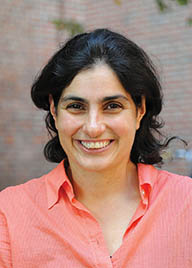
Prof Nergis Mavalvala: "right combination of opportunity"
For over a decade Mavalvala worked with a team to devise an automatic alignment system that was incorporated into the Laser Interferometer Gravitational-wave Observatory (LIGO), a joint project between MIT and the California Institute of Technology. "Making the mirrors stay still is something we devote a lot of attention to,” Mavalvala was quoted by sciencemag.org. "If there is misalignment, the beam could just walk off into the desert instead of hitting its partner,” she added.
Her scientific breakthrough elicited hundreds of comments under news articles and Facebook posts with many readers having attributed her success to: her Pakistani roots, the Parsi community she belongs to and her schooling at Karachi’s Convent of Jesus and Mary. Commenting on the euphoria in Pakistan, Mavalvala’s message was: "Anybody should be able to succeed — whether you’re a woman, a religious minority or whether you’re gay. It just doesn’t matter… And I am proof of that because I am all of those things. With the right combination of opportunity, it was possible for me...
"Growing up, I didn’t know there was a subject such as astrophysics. I did know there was physics and I did know there was a sky filled with pretty interesting objects…I was pretty young when I started to learn about the night sky. I used to live in the Clifton neighborhood in Karachi in an apartment building and would go to the rooftop of the building on certain nights of the year when there were meteor showers and look at meteorites … I had this kind of typical wonder about the universe. I was also extremely interested in how the universe began,” she related recalling her refusal to believe in any other religious explanation for these things even as a child.
"My parents (Minoo and Meher Mavalvala) are not scientists and don’t necessarily fully follow the things I work on. But they have always been supportive. They always felt ‘if this is what she wants to do, let’s get out of the way and let her go with it’ — that’s a powerful situation to grow up in…There was no pressure to do something that was their dream rather than mine… I grew up in a family where the stereotypical gender roles were not really observed,” Mavalvala recalled how she would borrow tools from the bike mechanic across the road to fix her own bike. "So I grew up thinking women can, must and should do anything and everything. That is very important for me,” the astrophysicist was quoted in the Karachi daily, Dawn, February 15, 2016.
She considers herself a product of good mentoring, from the chemistry teacher in Pakistan who let her play with reagents in the laboratory after school to the head of the physics department at MIT, who supported her work when she joined the faculty in 2002. The astrophysicist was appointed associate department head of physics a year ago. After a BA in physics and astronomy from Wellesley College, Mavalvala earned her PhD in physics from MIT. A major boost for her was the MacArthur "Genius Grant” she received in 2010, which came with a $ 500,000 stipend (see "Waves of research,” Zoroastrians Abroad, Parsiana, December 21, 2010).
For the present, Mavalvala realizes that the discovery of gravitational waves is just the beginning for it has "opened up more questions that you need to answer. It’s really fun!”