Surmounting all odds the 12th World Zoroastrian Congress was able
to draw nearly 1,200 delegates, including 400 youth, to New York
Text: Parinaz M.Gandhi • Photos: Jasmine D. Driver
Thirty-six mobeds and mobedyars from different countries, in diverse age-groups, both males and females, clothed in varying attires in white, walked up the central aisle in pairs bearing lamps in their hands before proceeding to the dais. At the inauguration of the 12th World Zoroastrian Congress (12WZC) at the New York Hilton Midtown on July 1, 2022 they epitomized the theme "Bridging the Global Zarathushti Existence.”
"Today is a very auspicious day. Today is Behram roz. Join us and pray with us,” announced Ervad Tehemton Mirza, president of the North American Mobeds Council. The attendees in the Ballroom, heads dutifully covered as prescribed in the dress code circulated earlier, enthusiastically rose but did not expect they would remain standing for over 15 minutes while the priests recited the Atash Nyaish. As one member from the audience pointed out, the inaugural day also marked Tirgan, mah Tir, roz Tir according to the Fasli calendar.
"We have Zarathushtis from 16 nations with us here today,” declared Ferzin Patel, the master of ceremonies at the inaugural function, as she announced the names of the countries and the flag bearers as they walked up to the dais. The countries represented were Australia, Canada, France, Hong Kong, India, Iran, Iraq, New Zealand, Pakistan, Poland, Portugal, Singapore, South Korea, United Arab Emirates, United Kingdom and United States of America. Nearly 1,200 delegates had registered for the Congress including a few who chose to be online participants.
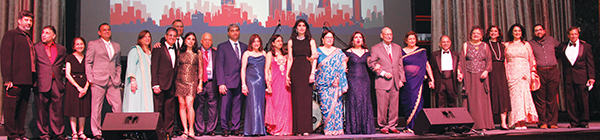
Organizing committee of the 12WZC
(Top)priests at the inauguration; (above) delegates in attendance at the Ballroom at New York Hilton Midtown
"Many more would have liked to attend but because of the backlog at the US consulates” they were unable to procure their visa on time, stated the Congress co-chair Astad Clubwala. While conceding that "we all are a product of our upbringing depending on where we are born, our financial circumstances, and influences of family, peers and education,” he urged those present to think for themselves and live together in peace and harmony with tolerance and respect. "I see great promise in the younger generation who are more open-minded and more aware of diversity. They will bring about the change the world needs and use their vohu mano, the good mind, towards promoting Asha,” he stated.
On behalf of the 27 member associations, 13 corresponding members and 25,000 Zarathushtis in North America, Arzan Wadia, co-chair of the Congress and president of the Federation of Zoroastrian Associations of North America (FEZANA), extended a welcome to all the delegates. "A year ago we were contemplating on cancelling the Congress (due to the uncertainties created by the pandemic),” he admitted. The organizing committee soldiered on. "We as the hosts cannot thank you enough,” said Wadia revealing how 75% of the registrants signed up before the early bird registration deadline. During the Congress sessions "you will hear things you agree with and what you may not agree with. Focus on the latter. We need to pick up markers and see where correction is necessary.” Giving due credit to the team of volunteers whose "love of community and the faith” propels them to serve selflessly, he cautioned the delegates, "There may be times when things may not go as planned… or we may surprise you. Give the volunteers a hug… Follow us on social media…”
The Congress being co-hosted by FEZANA and ZAGNY (Zoroastrian Association of Greater New York), Khursheed Navder, president of ZAGNY, referred to "the mammoth undertaking of organizing a Congress in the most expensive city in the country during an unprecedented pandemic and creating a memorable experience for all.” She hoped the Congress would offer "an opportunity to introspect, take stock of where we are and where we hope to be… while making new friends and catching up with old ones, learning and engaging in interesting, intellectual content.”
"We have gathered here today because of His mercy and His love. Let us not take His blessings for granted,” reminded Dastur Khurshed Dastoor of Udvada, wishing "strength, courage, patience and good health to all who have become direct and indirect victims of the pandemic.” He urged the delegates to be guided by vohu mano to spread righteousness, merit and harmony, and smite evil so that sins may be eradicated. A live message in Dari from Mobed Ardeshir Khurshedian, head of the Tehran Mobed Council, was relayed when unfortunately the acoustics failed in the Ballroom.
"Many feel that religion has become irrelevant… that Zoroastrianism is disappearing… We don’t believe that. Monumental problems call for spiritual renaissance,” asserted Keki Dadachanji who co-chaired the program committee with Aban Rustomji. "The strength of a religion is not measured by the number but the indomitable spirit of its followers. The Congress program is built around this theme,” added Dadachanji, citing the special deliberations woven into three-and-a-half days of the Congress from July 1 to 4. The unrehearsed elements are "the best parts of a Congress. Please participate respectfully. Connect and reconnect with people and have lots of fun,” he urged.
The heroes of the pandemic, individuals and organizations across the globe who worked for the safety of others, were paid a tribute through a short film specially created by the Zoroastrian Youth of North America and shown at the Congress inaugural.
Equality, education, entrepreneurship
In his keynote address on the first day of the Congress, delivered as the Prof Kaikhosrov Dinshaw Irani Memorial Lecture, Justice Rohinton Nariman (retd) spoke on "Gender Equality: The Right of Parsi Women after the Advent of the Constitution of India.” The 1908 Davar-Beaman judgment that is applicable to the community accepts the children of a Parsi father married to a non-Parsi as Parsi but children of a Parsi mother, even though she may be married to a half Parsi, are refused, pointed out the former Supreme Court justice. Enshrined in the Constitution of India is liberty of beliefs and equality to freely profess, practice and propagate one’s faith (to one’s children). "Change can come if the community demands it. I don’t think people in Bombay would. The only route therefore is for the constitutional bench (in the Supreme Court) to look at the vision of Gathas as propounded by Zarathushtra,” he declared.
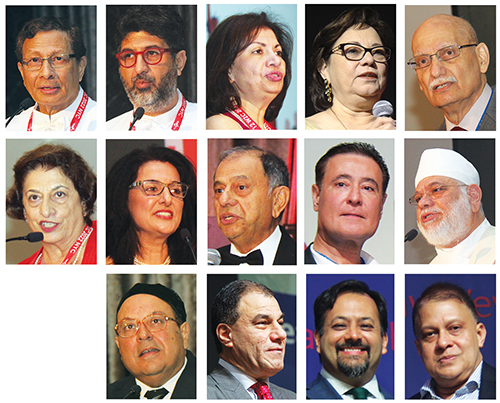
From l, top row: Astad Clubwala, Arzan Wadia, Khursheed Navder, Behroze Clubwala, Keki Dadachanji;
2nd row: Aban Rustomji, Ferzin Patel, Edul Daver, Dr Shahriyour Andaz, Dastur Khurshed Dastoor;
3rd row: Justice Rohinton Nariman (retd), Lord Karan Bilimoria, Drs Yuhan Vevaina and Jamsheed Choksy
The Khorshed F. Jungalwala Memorial Lecture on the second day took a novel shape when two Zoroastrian studies scholars, Dr Jamsheed Choksy and Dr Yuhan Vevaina, in conversation with academic Dr Nerina Rustomji, stressed on the vital role of historical and religious education for community members. Their thoughts on how Zoroastrian studies can be fostered and assimilated by the community provided meaningful context and continuity.
The distinguished speaker on the penultimate day was Lord Karan Bilimoria of Chelsea, UK who in his talk on "Leading through crisis the Zoroastrian way,” reflected upon how his beliefs and ideals have influenced his work, particularly as president of The Confederation of the British Industry over the past two years spanning Brexit, the pandemic and the war in Ukraine. Bilimoria was also invited to give the closing remarks at the session on "Making the Impossible Possible: Enhancing Global Zoroastrian Excellence Through Entrepreneurship.” This session succeeded in conveying the mission of the World Zarathushti Chamber of Commerce and the successful entrepreneurial journeys of the panelists with "purpose, passion, persistence and providence.”
Fundamental to the faith
Leaders of five religious faiths — Zoroastrianism, Christianity, Judaism, Sikhism and Hinduism — spoke about the spiritual commonalities in a well attended session on "Faith matters” on the opening day. Conversely the evening session on "Global Mobed Community: Serving Zoroastrians Worldwide” on the third day failed to draw a respectable audience despite repeated entreaties. Five priests from India, UK, USA and Australia shared their experiences of co-religionists adapting to their new homelands while retaining their Zoroastrian cultural and spiritual treasures.
In "Zoroastrian Voices from Iran,” Dr Sarah Stewart alluded to the religious rituals and traditional customs that have been modified to reflect contemporary constraints on time and space, a diminished priesthood and migration away from major Zoroastrian centers. The rise of Zoroastrianism in Kurdistan was covered in the session on "One Zarathushtra, many Zoroastrians: Iraqi Kurds reclaim their heritage.” An activist from Kirkuk, Iraq, Faiza Foad, referred to the motivation, aspiration and challenges for the Kurds who have declared themselves to be Zoroastrians.
The experiences of Zoroastrians from interfaith families and their assimilation into the Zoroastrian fold were understood in the session on "Identity, Belonging and Community in Zoroastrianism.” Their frank narratives and confession of their vulnerabilities were meant to help foster mutual respect and acceptance of differences in outlook as the future Zoroastrian community evolves.
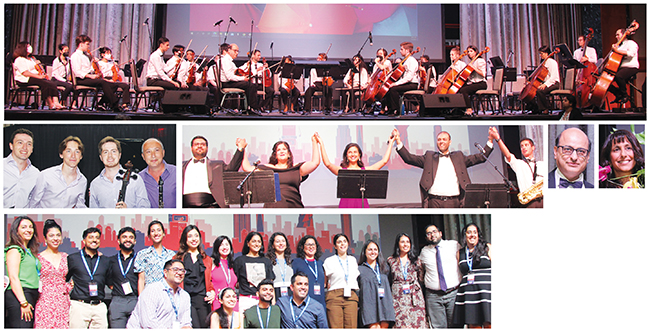
Top: World Zoroastrian Orchestra; 2nd row (from l): Charlie, Christopher, Cameron and Peyman Zandieh;
Malcolm Cooper, Tara Jamshidian, Meher Pavri, Ardavan Tareporewala, Yazad Tafti, Cyrus Mehta,
Piroozi Cooper-Wittlin; 3rd row: youth leaders at the Congress
Voices of today
The Zoroastrian Alliance of Sisters Here and Abroad (ZASHA) marked its presence with the launch of a website – zasha.info. An initiative spearheaded by Zerbanoo Gifford, the founder of Asha Centre in the UK, ZASHA is geared to connect and empower women to lead their communities and participate in the global arena through education, social campaigns, businesses, books, events. Gifford was moderating the session, "We the Zoroastrian Women: Voices of Today, Leaders of Tomorrow.” Known to "hold culture and faith together,” Zoroastrian women are "awesome, incredible champions of the world… who need to be given courage and confidence,” remarked Gifford. One visual at the session that impacted the audience read: "The Future is Here” for a considerable duration until the ‘e’ from the word ‘Here’ was crossed out to read: "The Future is Her.”
To show the emergence of youth leaders around the globe, some of them were on the dais while others were stationed in different areas of the Ballroom as they participated in the session on "Leaders asking Leaders: Q&A with Youth Leaders from around the Globe.” As they addressed questions from their peers and the audience, they shared their experiences of community involvement.
In addition to the adult sessions, a parallel program reflecting Zoroastrian ideology was drawn up for the Tweens aged between 11 and 15 and for the children aged between five and nine.
Value and bias
In her talk on "Blind Spot: Hidden Biases of Good People,” Dr Mahzarin Banaji showed through her teasers and anecdotal references how our well-meaning behavior could be inconsistent with our values. Frequently, our choices are driven by ‘implicit’ preferences and beliefs.
The Avestagenome Project, as explained by Dr Viloo Morawala-Patell, has created a comprehensive biobank – data base of Zoroastrians. This should help in deeper understanding of human disease and precision medicine that is expected to drive healthcare and provide tailored treatments and prevention strategies allowing for unique characteristics.
The inherent respect for environment came across in the session on "Custodians of Zamyad — The Spirit of the Earth.” The efforts of the panelists to confront environmental issues reflected their commitment to maintain and "worship the earth which gives good gifts.”
While all the above sessions were conducted in the Ballroom, the breakout sessions, occasionally at four different rooms at the Hilton simultaneously, ensured that the delegates were spoilt for choice.
The evenings were reserved for music and entertainment. The performance by the World Zoroastrian Orchestra, directed by Piroozi Cooper-Wittlin, with Cyrus Mehta as assistant director, songs by Malcolm Cooper, Meher Pavri, Tara Jamshidian, Tina Siganporia, Ardavan Taraporewala, Kerissa Lalkaka, Pia Sutaria with piano accompaniment by Jamshed Turel and Neville Dusaj on different days showcased the musical talent in the community. "One World, One People” was fashion designer Ashdeen Lilaowala’s contribution to the Congress at the Gala Banquet night. At the inauguration, it was the Zandieh family, father Peyman on the clarinet, and sons Cameron on the violin, Charlie on the cello and Christopher on the piano who performed the Persian Rhapsody, composed by Christopher. The Story of Creation: As told in the Bundahishn — a multimedia presentation — saw nearly 40 members participate in the show directed by Shahnaz Shroff and produced by Kaizad Darbari.
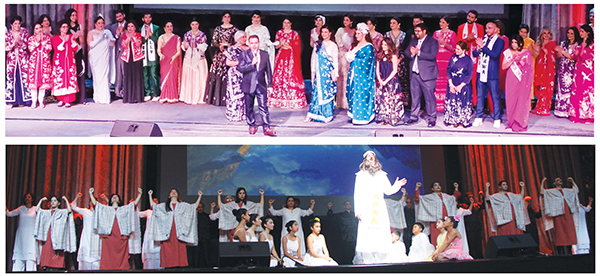
(Top): "One World, One People" showcasing Ashdeen Lilao- wala’s creations;
(above): enacting The Story of Creation: As told in the Bundahishn
Youth from New York hand over WZC trophy to the team from Singapore
The iconic and rising stars
Sixty-seven nominations were received for the seven award categories including the newly instituted Diversity Award that recognizes an individual, project, organization or institution for outstanding contributions to improving gender and racial inclusion, equity and diversity. Of the 18 community members who were named the recipients, there were only seven who could come in person to receive their trophy. "Considering the very rich pool of high achieving candidates, the Awards Committee decided to offer multiple awards in some categories to recognize the contributions of excellent nominees,” noted the Awards Committee co-chairs Meher Bhesania, Noshir Langrana, Adil Mistry and Yazdi Tantra in the leaflet introducing the awardees. The Iconic Zarathushti Award went to the husband and wife team of Fali and the late Bapsi Nariman as also Dr Cyrus Poonawalla. The Community Service Award to Shernaz Cama and Edul Daver; Science/Technology/Engineering/Medicine Award to Dr Firuza Parikh; the Social Entrepreneur Award to Zerbanoo Gifford, Ruyintan Mehta and Zarina and Ronnie Screwvala; the Creative Art/Design/Literature/Culture Award to Bapsi Sidhwa; the Diversity Award to Farah Bala and Michelle Mama; the rising Outstanding Young Zarathushti Stars Award to five recipients Tanya Hoshi, Parshan Khosravi, Mehrzaad Mogrelia, Sheherazad Pavri and Rishad Surti.
Lasting legacy
"Zoroastrian Footprints” has been conceived as the legacy project of the 12WZC. Recognizing that the population of Zoroastrians in the homelands of Iran, India and Pakistan has been rapidly declining while there has been a steady increase in the diaspora, they are keen to capture all available information and to keep adding in perpetuity. "A multilingual, global system that will collect, preserve, organize and share all things Zoroastrian from all available sources to provide a rich resource for the community and ensure that this information is available for prosterity,” is the vision of this project. "We need a lot of volunteers with different language skills, with different expertise. We want to start as soon as possible. Information is disappearing even as we speak,” Astad stressed on the urgency.
Recognizing that the youth can "build bridges between regions and make connections within our communities,” the Zarathushti Youth Across Borders program selected 26 students from India, Pakistan, Iran and the UK to participate in the 12WZC with the Congress organizers offering to bear their travel costs, hotel and registration fees, estimated at USD 3,000 (Rs 2,22,000 each). Unfortunately 16 of them could not procure visas.
To organize a Congress of this magnitude requires financial support from sponsors. The diamond sponsor for the 12WZC was Dr Shahriyour Andaz, a cardiac and thoracic surgeon. In a brief introduction to the benefactor who contributed $ 100,000 (Rs 77.57 lakh), Daver, co-chair of the Fundraising Committee, mentioned at the Gala Banquet that Andaz was raised in Poona and graduated from the Grant Medical College in Bombay. Having earlier contributed to the Dar-e-Meher Maintenance Fund in New York, Daver approached him for a donation for the Congress which he gave willingly. When invited to speak at the Congress, Andaz declined. Briefly taking the mike from Daver, the donor jested, "What Edul did not tell you was that he held a gun to my head!” Before resuming his seat, he dramatically pumped the air with a clenched fist, and proclaimed, "We Zarathushtis rock. We rock.”
The Zoroastrian Charity Funds of Hongkong, Canton and Macao served as the jade sponsor contributing USD 35,000 (Rs 27.15 lakh) even though not a single trustee from there was able to attend the Congress due to strict travel and quarantine restrictions. The three gold sponsors: Rakesh Bansal of New York Life Insurance Co/ NYLife Securities, LLC/ and John Hancock, Aashish and Dinyar Devitre, Tata Consultancy Services contributed USD 25,000 (Rs 19.39 lakh) each and the 27 silver sponsors $ 10,000 (Rs 7.75 lakh) each.
In addition, the Congress benefitted from institutional supporters and session sponsors, friends and supporters of WZC. In-kind contributions came from Anaheet Guzder who gave copies of ABC for Zarathushtis and Niloufer Mavalvala whose recipe book The World of Parsi Cooking: Food Across Borders was included in the welcome swag bag, specially designed and gifted by Dhun and Phil Shroff of Dilemma Inc. Along with the name tags on differently colored lanyards to differentiate the organizers, volunteers, speakers, media and delegates, included in the registration bag this time were a sanitizer bottle and a tissue packet, the dependable Covid countering companions. The heaviest feature though was the 188-page Congress brochure bearing messages from the Congress organizers and dignitaries, and carrying introductions to the sessions and speakers, most printed in such small font sizes that it would be difficult for an aging community to read. Images of New York started the brochure while the advertisements and sponsors were carried towards the end.
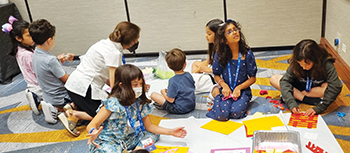
Parallel children’s program at the Congress
For "the Congress junkies” keen to tie up their holidays with Zoroastrian meets, the venues of the future congresses were announced. The Eighth World Zoroastrian Youth Congress for those in the 18 to 37 age group will be hosted by the Zoroastrian Trust Funds of Europe at the Radisson Blu Edwardian Heathrow in London from July 21 to 26, 2023 for which the earlybird registration (inclusive of accommodation and most meals) is UKP 550 (Rs 52,600). This will be followed by the global conclave of the World Zarathushti Chamber of Commerce at the same venue from July 27 to 29. The Parliament of the World Religions will hold its annual meet in Chicago from August 14 to 18 next year.
The 18th North American Zoroastrian Congress will be held in Houston, Texas from December 29, 2024 to January 1, 2025 with the theme of the Congress being "Generation Z: Propelling Zarathushti Resurgence.”
The 13th WZC will be hosted by the Parsi Zoroastrian Association of Singapore in 2026. Trust in the abilities of the 400-strong community to organize the Congress was reposed by the Global Working Group whose activities were alluded to in the session on "Linking Arms Across the World.” "Overwhelmed” by the current Congress and "thrilled” at the prospect of hosting the next one, president Homiyar Vasania urged those present to "help us organize, support and finance the Congress, and come as a contingent” just as nearly 10 of them had come from Singapore to New York.
Before leading the assembly in a concluding humbandagi with two Yatha, Yenghe Hatam and Ashem Vohu prayers, Dastoor urged the gathering to desist from using the Parsi/Irani nomenclature. "We will all be Zarathushtis,” he announced for which he received a standing ovation just as the audience frequently rose to applaud inclusive statements made by many other speakers.
Detailed reports on the talks and sessions at the Congress will be carried in forthcoming issues of Parsiana.