Supreme Court Justice Jamshed Pardiwala points out the damage
caused to the judiciary by an unregulated social media
Personal attacks against judges harm the rule of law, observed Supreme Court Justice Jamshed Pardiwala, delivering an address on "Vox Populi vs Rule of Law: Supreme Court of India,” at the Justice H. R. Khanna Symposium, on July 3, 2022. Noting that media trials were not healthy for the rule of law, he called for regulation of social and digital media. "In India, which cannot be classified as a completely mature or informed democracy, social digital media is employed frequently to politicize purely legal and constitutional issues,” Pardiwala was quoted by the legal website livelaw. He wanted Parliament to "look into the issue of regulation of social and digital media, especially in the context of sub judice trials in sensitive cases.
"Social and digital media is primarily resorted to for expressing personalized opinions more against the judges, rather than a constructive critical appraisal of their judgments. This is what is harming the judicial institution and lowering its dignity… In a democracy, we agree to live by the decisions of the court. It does not mean that court decisions are right; we will still agree to live by them.”
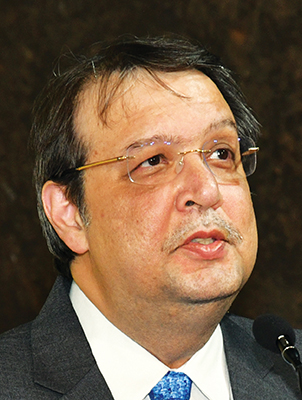
Justice Jamshed Pardiwala
"The remedy for each judicial order or a judgment is ‘clearly not available before the digital or social media but a superior court of law in the judicial hierarchy,’” he said, according to a report on theprint website.
Pardiwala cited the Navtej Singh Johar judgment, which decriminalized homosexuality in India, as the "finest example” wherein the Supreme Court upheld the rule of law as opposed to the opinion of the public. He mentioned the landmark verdicts of the Supreme Court on issues of Sabarimala Temple, LGBTQ (lesbian, gay, bisexual, transgender, queer) rights and death penalty to highlight the friction between aspirations of society and the necessity of upholding the rule of law.
While speaking on the life and legacy of the late Justice Khanna, Pardiwala also quoted The New York Times, which wrote on Khanna: "The submission of an independent judiciary to absolutist government is virtually the last step in the destruction of a democratic society.”
Pardiwala mentioned that Vox was first used by the English Archbishop of Canterbury against King Edward II who the Archbishop wanted removed from the throne, reported livelaw. Thus, the term was initially used in a negative light. He said that balancing vox populi or the will of people with the rule of law was difficult and required extreme judicial craftsmanship. "What will people think?” or "Log kya kahéngé (what will people say?)” is what comes to the mind of all judges when adjudging upon an issue which has social ramifications.
Pardiwala’s speech was made two days after a Supreme Court bench headed by Justice Surya Kant and he rejected a petition by the former Bharatiya Janata Party spokesperson Nupur Sharma to club multiple criminal cases registered against her for "disparaging remarks” on Prophet Muhammad she uttered in a television debate on May 27. The bench took a grim view over her irresponsible statements and held her accountable for the violent protest that followed especially in Uttar Pradesh and a beheading in Udaipur.
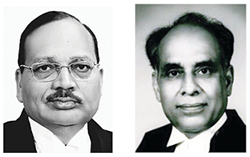
Justices Surya Kant (l) and H. R. Khanna
"The observation triggered massive outrage over social media with many rightwing supporters condemning the judges for their decision and observation,” stated theprint.
Writing in defense of the two SC justices, former Delhi High Court Justice Rekha Sharma in a column in The Indian Express of July 11 stated: "The Supreme Court sought to highlight the grave consequences when communal passions are given a free run, or are seen to enjoy state patronage. The apparent intent of the Court was to put brakes on the motor mouths who frequently make inflammatory statements which give rise to hate, build up communal tension, cause social unrest. Unfortunately, soon after the Supreme Court’s observations, the troll army supporting Sharma started trolling the judges, particularly Kant, who reportedly did most of the talking. The words spoken by the judge were twisted to build a false narrative…
"The Supreme Court also turned the heat on the Delhi Police. It reportedly said that the Delhi Police must have laid a ‘red carpet’ for her (Nupur Sharma) and that when she makes a complaint the person is arrested. But even when there is an FIR (first information report) against her, she is not touched which speaks of the clout that she enjoys. The Supreme Court was fully justified in making this observation against the Delhi Police. The manner in which it is conducting its investigation in Sharma’s case bears testimony to this.”
Journalist and fact checker Mohammed Zubair who Tweeted a clip of Nupur Sharma’s television outburst was arrested for allegedly "insulting Hindu religious beliefs,” reported bbc.com.
"Given the selectivity with which the Delhi Police has been arresting or not arresting the accused, especially in cases with political or ideological overtones, it is no longer enough to merely castigate the police,” noted Rekha Sharma. "The role of the judiciary is not only to interpret, but also to apply the law, and to prevent its mutilation.”