The Mughals brought with them the Persian language which affected all aspects of life in India
Dr Kiran Paithankar
Persian, one of the oldest languages in the world, has had a major linguistic and literary influence over Indian languages. The greatest interaction between the Iranian and Indian nations occurred during Mughal rule when the impact of Persian was evident in all aspects of life in India. With the influence of Iranian culture and language emerged an entirely new style of poetry and prose in Indian literature. According to scholar A. D. Safavi, "the interaction of Indo-Iranian cultures also gave birth to a new language, Rekhta or Urdu which is a synthesis of Hindi, Persian and Arabic words.”
Akbar, the powerful Mughal emperor used Persian as the official court language. As a result, many major Indian languages absorbed words and idioms from that language which percolated into Hindi, Urdu, Bengali, Marathi, Gujarati, Punjabi and Telugu. Persian is directly related to the Indo-European languages. Also known as Farsi, it is primarily spoken in Iran, Afghanistan (officially known as Dari since 1958) and Tajikistan.
In the early 13th century, when Bengal was conquered by the Muslim leader Ikhtiyaruddin bin Mohammad Bakhtiar Khilji, the people of that area accepted a new culture, according to scholar Dr H. M. Tahir Ali. Bengalis tried to learn the new language, and a number of Persian words, phrases and idioms enriched their language. Some of the borrowed words are bandara (port), śakta (strong), skata (Scot) and jangala (jungle).
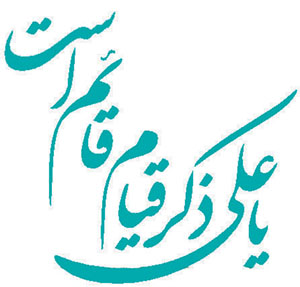
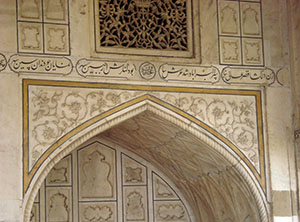
Persian calligraphy and on a religious structure Photos: Wikipedia
Urdu is replete with Persian words, phrases and idioms. Scholar H. Bahri argued that "the most important influence of Persian on Hindi, it has been recognized, was the growth and development of Urdu language and literature.” Many words from the Persian vocabulary have been used along with compound words in Urdu, such as karna (to do). For instance: qabool kardan, qahbool krna (to accept), shak kardan, shak krna (to suspect), mahroom kardan, mahroom krna (to deprive), safar kardan, safar krna (to travel).
Hindi, adopted as India’s official language, used Persian words right up to the 20th century. These were written in the Devanagari script instead of the Urdu or Persian scripts. Some of these are rah (way), tang (narrow), zahar (poison) and iman (faith).
Persian culture entered Maharashtra with the conquest of Alauddin Khilji (1296-1316) and increasingly influenced Marathi language and culture. Later, Mohammad bin Tuglaq Shah I (1325-51) deported a large portion of the population of Delhi to his new capital Deogir (Dēvgiri, renamed Dawlatābād), which strengthened the process. As Abdul Haq has noted, the increasing influence of Persian on Marathi was due to a number of factors. Eknāth, a famous Marathi poet (early 17th century), used many Persian words and idioms in his Marathi writings. His poem Arjadāst (arża-dāšt) starts with a Persian phrase and contains many Persian terms such as bandagi (servitude), bandinevāj, banda-navāz (kindness to inferiors), harāmzādi, arām-zāda (illegitimate), kārkon (toiling, industrious), savār (horseman), zamindār (landlord), zebardast (skilled), čubdār (mace-bearer, sheep-seller), parvānagi (official permit), rowšan (bright, wise). Other words absorbed into Marathi include karar (contract), aarz (application), aastar (lining) and umda (chief, wholesale).
Parsi Gujarati differs from ordinary Gujarati in that it admits pure Persian words in considerable number, especially in connection with religious matters, in addition to a host of Arabic and other words taken from Persian. For instance jangal (forest), tanal (tunnel) and dushman (enemy).
The establishment of the princely state of Hyderabad by the Asaf Jah dynasty in 1724 heralded an era of Persian/Arabic influence in Telugu, the language of the people of Hyderabad. Its effect is also felt in the prose of the early 19th century, as in the Kaifiyats (memoirs with historic significance). Telugu has words like madar (mother) and daglas (Douglas).
Persian has long had a major linguistic and literary influence on Punjabi, as might be expected from that state’s location in the northwest of the Indian subcontinent. Punjab, the region traversed by the five tributaries of the Indus, gave it its Anglicized name with roots in the Persian panj āb (five waters). Other Persian words borrowed by Punjabi are bihatara (better), siganala (signal), sharama (shame), garadana (neck), Dasabara (December).
 A medical practitioner registered with the Indian Board of Alternative Medicines, Calcutta, Dr Kiran Paithankar, 44, has been awarded the Board’s Dhanwantari Award. He is also engaged in research on the origin of Vedic Sanskrit and Old Persian and its script as well as the influence of these languages on Indian tribal languages.