Magnanimous donations to Zoroastrians, amounting to £ 32,000 (Rs 27,20,000), constituted over one-fifth of the £ 142,400 (Rs 1,21,04,000) largesse extended by The Erach and Roshan Sadri Foundation (ERSF) of UK, in the first quarter of 2012. Whilst the Ratan Tata Institute benefited from a donation of £ 12,000 (Rs 10,20,000), the World Zoroastrian Organisation (WZO) will use £ 20,000 (Rs 17,00,000) as scholarship grants, as per the summary of the grants posted on the ERSF website www.ersf. org.uk As further specified on their website, "The Foundation will look favorably on applications made by Zoroastrians either on behalf of members who are disadvantaged or for projects they support. Community projects as well as appeals for disadvantaged or poor individuals are encouraged.”
"Applications from individuals are not encouraged but funds are given to associations which are set up to select and monitor individuals,” noted a write-up on the Foundation in Hamazor, Issue 4, 2011, by Sammy Bhiwandiwalla who is one of the five trustees, the others being two members of the Sarosh family (Roshan’s maiden name being Sarosh), Darius Sarosh and Jehangir Sarosh, Margaret Lynch and Shabbir Merali. Over the years, causes in UK, India, Pakistan, Afghanistan, Nepal, Iran and Africa have been promoted. "All grants given are closely monitored to ensure the funds are used for the purposes intended,” clarified Bhiwandiwalla. When visiting Bombay in November 2011 Darius told Parsiana, "We are focusing on stronger linkages and partnerships with regional charities across India.” He referred to their help to around half a dozen charities in Bombay and an equal number in Madras.
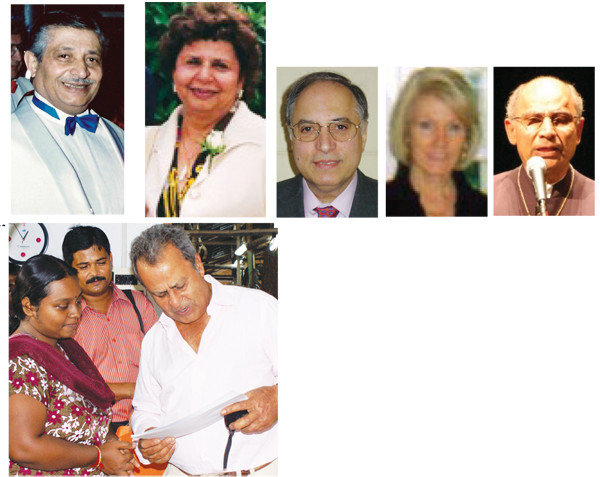
(Top): Benefactors Erach and Roshan Sadri; (center, from left): trustees Sammy Bhiwandiwalla, Margaret Lynch, Jehangir Sarosh; (below, far right): Darius Sarosh at an ERSF sponsored orphanage in Calcutta
Having contributed nearly half a million to worthy Zoroastrian charities the ERSF sees its aim as "getting money to where it is required; not getting involved in the politics of an organization,” asserts Darius declaring that "my sister (Roshan) did not specify” which causes to support. Hence they extend aid for the WZO work for the rural Zoroastrian farmers of Gujarat, restoration of manuscripts at the K. R. Cama Oriental Institute, educational scholarships…
Besides the Zoroastrian objective, in the first quarter of 2012, funds amounting to £ 68,000 (Rs 57,80,000) were contributed under the ‘welfare’ head, the beneficiaries being Action for Africa, Sane and Enthusiast Volunteers’ Association of Calcutta that works for mental health, BETA that is sinking shallow wells in Tanzania, Freedom to Learn, a child welfare organization in Nepal and The British Forces Foundation that is actively promoting mental health and supporting Frontline anti posttraumatic stress work for those serving in the military in the hostile regions of the world.
In the field of education ERSF donated £16,000 (Rs 13,60,000) towards the training center of the Society for the Education of the Crippled and £ 7,800 (Rs 6,63,000) for the early intervention program of Vidya Sagar. To alleviate ‘Homelessness’ ERSF contributed £ 18,500 (Rs 15,72,500) to Canopy Housing Project that strives to provide affordable homes, as per the website.
ERSF was established in 2005 following Roshan’s demise in 2003 when as per the social worker’s will she instructed her executors to set up a charitable foundation. Her husband Erach had predeceased her by 13 years. With their cheerful disposition and willingness to surmount all odds, the newlyweds had started life in Afghanistan where Roshan was a teacher and Erach flew Dakotas, before they returned to UK. Thereafter Roshan pursued her duties as a social worker and Erach launched Housemasters, a company that imported luggage, travel goods and household items in UK.
The legacy that was worth approximately £ 6.5 million (Rs 55,25,00,000) at its peak seeks to build a long-term relationship with its partners. The trustees prefer to extend aid to a few chosen charities. Darius reiterated the need for collaboration between charities pointing out how some may be good at health prevention whilst others with runaway children or trauma victims or training or microcredit. "To maximize benefits, sharing of experience is essential,” he believes. Referring to "the forgotten majority who are not benefitting from the growth in India” he advocated the need to share management skills and time to uplift others.
He was impressed with the prevailing culture in England where the youth are willing to work in a supermarket to raise funds to promote education in Uganda. Instead of solely depending on overseas charities for funding, nongovernmental organizations should attempt to raise funds, he stressed. He cited the activities of their Golf Club that undertakes to raise monies for charities each week. When top celebrities and stars give concerts to fund charities, or someone performs an unusual feat of jumping out from a plane, such events help "to create social responsibility instead of merely paying lip service,” he is convinced.