The ability to meet targets depends on soft skills and a series
of human interactions
Edul Daver and Nina Mistry
Parsiana requested veteran fundraiser Edul Daver to write an article on fundraising stating "As a very successful fundraiser for FEZANA (Federation of Zoroastrian Associations of North America), ZAGNY (Zoroastrian Association of Greater New York) and other associations and institutions, we wondered if you would write an article on what it takes to raise funds for a community charitable organization?”
We are humbled. By no stretch of imagination are we professional fundraisers. In fact, we knew nothing about fundraising until 2011 when Edul was charged with raising significant funds for construction of the new Dar-e-Mehr (DM) in New York (NY).
The goal was to raise three million dollars (Rs 24.6 crore), the original estimate for the new building. Many thought it was just a pipe dream, but by the time we were done, the scope had increased and we successfully raised five million dollars (Rs 41 crore). Next, we needed to provide for the maintenance of the new DM and raised an additional one million dollars (Rs 8.2 crore) for the Operating Expense and Maintenance Fund. Then came the 12th World Zoroastrian Congress in NY where the high cost of hosting the event made it imperative to subsidize registration, necessitating considerable funds (that too, during a pandemic!). To everyone’s disbelief we exceeded even the most optimistic target. On the heels of these successes, and drawing confidence from artist Bob Ross’s words, "There’s nothing in the world that breeds success like success,” we launched the Zarathushti Entrepreneurship Development Foundation (ZEDF) initiative to raise a corpus of one million dollars to fund budding Zoroastrian entrepreneurs with interest-free loans. The effort is off to a good start with USD 243,000 (Rs 1.99 crore) collected [further support is welcome to help us achieve our ambitious one million dollars target (contact Edul Daver at
eduldaver@gmail.com for further information)].
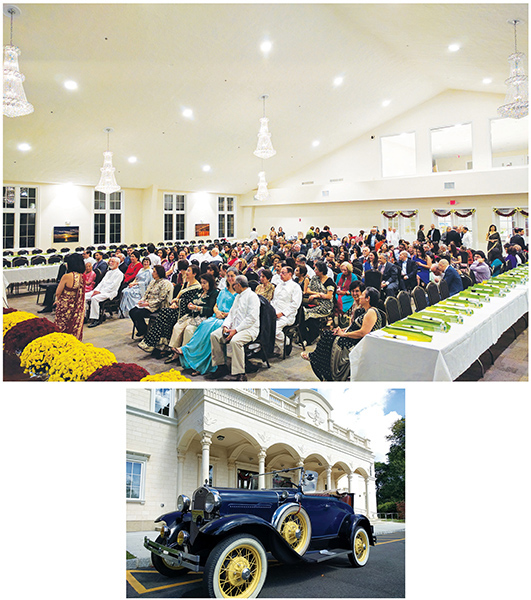
Top: Jamva Chaloji dinner and (above) rides offered in vintage car as fundraising efforts
So, how do we make all this happen, not just once by chance, but repeatedly?
Several factors contribute to these success stories.
At the outset, we acknowledged the need to learn how to approach fundraising. We are thankful to Behram Irani for sharing his expertise and making the trip from Dallas to NY to give us a two-day crash course on the science behind fundraising — teaching us how to develop a fundraising team, create potential donor lists (whom to ask), generate ask targets (how much to ask for), analyze results (how to ask), and encouraging us to continuously review and revise the success metrics to be effective. Bursting with data, numerous spreadsheets and unbridled enthusiasm, we set forth with this new-found knowledge.
Initially, donor outreach received a tepid response. It was a trial and error process until we intuitively developed the soft skills needed to make the science work for us, ultimately honing the art of fundraising. We now appreciate that the art of fundraising is merely a series of human interactions — rational, emotional, and sometimes even irrational. It involves conveying the objective, making it into something real and transformational, yet simple. We understand the need to connect with donors consistently, emotionally and mentally to convince them about the power of the simple act of giving. "The simplest acts of kindness are by far more powerful than a thousand heads bowing in prayer,” as Mahatma Gandhi had said.
As we gathered pledges and donations, we quickly realized that there is inherently much more to fundraising than the science and art behind the process. The importance of donor appreciation and recognition; providing constant communication with information updates; cultivating relationships and nurturing them with TLC (tender, loving, care); being creative and flexible are all equally critical.
Based on our experience, below are highlights of the road map to our success stories:
Plan
Identify what the funds are needed for and the target amount (revisit this target periodically).
Develop a clear narrative to communicate with potential donors in a simple, rational, and justifiable way.
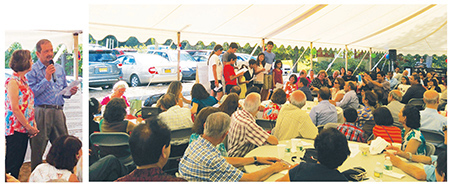
From l: major donors Shernaz and Feroze Bhandara; youngsters expressing a desire for a new building
Team
Form a team of like-minded people who demonstrate the following characteristics:
they believe in the project passionately; they are committed to giving their time and resources;
they are energetic, can communicate with donors, and listen attentively;
they have integrity and donors can trust them without any reservation;
they are approachable and easy to work with.
Designate a team member to maintain accurate records of all pledges/payments received and establish credibility.
Lead by example
Most importantly, fundraisers must lead by example. Key leaders of the team must walk the talk by making significant pledges/donations and a few should be at the high end of what is expected from the best donors.
Develop a strategy
A salesman at General Electric exceeded every sales record year after year. He was a simple man, not noticeably charismatic, but to everyone’s surprise had outstanding sales results. At his retirement party he was asked to share his winning strategy. He stood up and rather diffidently said, "I don’t have much to say, and can sum up the reason for my success with three words, ‘one more call,’” and sat down. This true story inspired us to follow the principle of "one more call” that has proved to be central to our success stories.
Start with outreach to potential donors who will almost certainly lend their support (first harvest the low-lying fruit).
Make no assumptions about potential donors’ ability or capacity to give.
There is little correlation between the capacity to give and giving, but the correlation between the mindset to give and giving determines donor behavior.
If donors are not ready to give when asked, begin by getting their buy-in and follow up for pledges/donations — patience and persistence pays if it does not become a nuisance or irritation to the donor.
Do not stop asking, make that "one more call” — it is a winning strategy!
Do not limit the ask to Zoroastrians. A non-Zoroastrian friend/colleague/business may very well have connections to the community and reasons to give.
Do not exclude other associations, foundations, trusts, etc. e.g. the NY DM Building Fund received recognition-sized donations from non-Zoroastrians and other associations/foundations.
After all, "if you don’t ask, you don’t get it,” said Mahatma Gandhi.
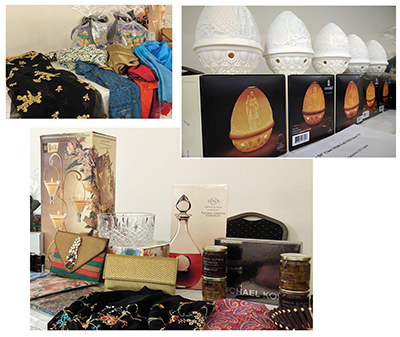
Top and above: sale of handicraft items and Lladró votive
The ask process
Mass appeals (printed/electronic) yield limited results. However, they help create awareness, disseminate information and lay a foundation for the fundraising team.
Individualized written requests/phone calls must follow the mass appeal in a timely manner.
Tailor the ask process for each donor based on the relationship with the donor.
Be mindful of donor preference in communicating (email/text/WhatsApp or phone call).
Facilitate the process by creating a ready-to-share list of payment options (information for online payment, bank transfer, stock donation, charitable giving, company matching).
Adopt an organized approach by assigning the team member most likely to get the maximum positive outcome from each donor. In our experience, it is counterproductive to inundate donors with the same request from multiple team members.
Where appropriate, solicit help from donors to identify other potential donors — remember people like to feel helpful and involved.
Do not put the donor in a position to say "No.” If, however, the answer is a definite no, respect it and move on but always keep the door open to revisit and under no circumstance burn bridges.
The ask amount
Studies by the National Institute of Health indicate that when people give, the brain releases hormones such as dopamine and oxytocin that contribute to feeling good like when we listen to music or engage in other satisfying activities. Research also suggests that generally people like to give, but do not know to whom, how, and how much to give. Hence, it is advisable to ask for a specific amount or indicate a range based on knowledge about the donor. Asking donors to give whatever they are comfortable with is not the best practice and could leave money on the table.
Recognize that donors do not necessarily give to the organization but give because of the individual doing the fundraising. Fundraisers should approach the ask from the perspective of helping the donor feel good by giving ("We would love to include you on our growing donor list”). A donor, Shailendra Dusaj, commented that the donation he had just given us had zero impact on him financially as it did not make him feel richer or poorer, but it did make him feel good and so he was going to give again next year. A testament to the words of Winston Churchill, "We make a living by what we get. We make a life by what we give.”
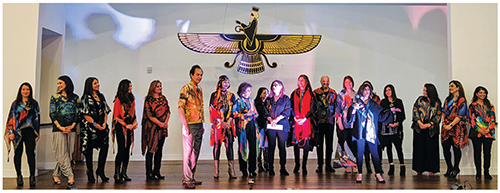
Fashion show with sale of Dilemma fashion wear, Phil and Dhun Shroff (6th and 8th from l)
Recognize sponsors/advertisers
Creativity and flexibility are the name of the game! Also, embrace the concept that donors must be treated like royalty to make them want to repeat the giving experience and feel proud to be associated with the organization/initiative.
Create sponsorship/advertising campaigns with equitable and adequate recognition.
Consider the value in creating a tiered model offering several categories for sponsorship/advertising and establishing recognition with tangibles where possible (higher categories having donor names associated with a room or prominently displayed on a recognition board or in the case of advertising, names on the back cover or centerfold).
This is typically where substantial monies come from, so do not set the lowest recognition level too low as majority of donors gravitate to this level.
Expect the Pareto principle to apply, which states, "for many outcomes, roughly 80% of consequences come from 20% of causes” — e.g. the NY DM Building Fund totaled about USD 5,000,000 from 400+ donors, of which the Room Recognition Campaign raised about USD 2,900,000 (Rs 23.78 crore) from 17 donors.
Display donor lists. It inadvertently generates a competitive spirit, encouraging donors to give or give more to move up to a higher category.
Importantly, provide flexibility to meet donor requests, i.e. "Dance with the donor while letting the donor lead.”
Fundraising events
Fundraising events may not always raise significant funds relative to the effort expended. However, they are vital in raising awareness, building community spirit, generating enthusiasm, closing a funding gap, and creating a ripple effect that indirectly increases giving. The Lladró votive fundraiser, led by Behroze Clubwala and Rohit Bansal, was instrumental in raising awareness for the NY DM globally, generating significant funds through world-wide participation. The popular "Jamva Chaloji” gala, led by Nina Mistry and Percis Bansal, complete with gara-dagli and patra-nu-bhonu served paanth-style by volunteers has been unparalleled at fostering community spirit. The donation match pledge introduced by Aashish and Dinyar (Dinny) Devitre generated so much enthusiasm that the concept has been repeated several times with a positive outcome every time. The idea from Farrokh Patel to get us to the finish line when we needed USD 400,000 (Rs 3.28 crore) to complete the NY DM building got us to pitch a tent, provide lunch and bring people together to tour the unfinished building. The excitement was so infectious, people collectively gave about USD 700,000 (Rs 5.74 crore) surpassing the target that day.
A dynamic team eager to think innovatively and infuse energy through fundraising events at regular intervals, is invaluable.
Post fundraising
It is important to continue to engage with donors once the target is achieved and provide feedback on the use of funds. Make donors feel proud of giving by highlighting what their contributions have made possible.
Show appreciation and promptly send thank you notes with copies (electronic/hard) of brochures/programs/mementoes/other relevant materials. This is an area our team might work on improving, taking to heart that "People will forget what you said, people will forget what you did, but people will never forget how you made them feel,” as said by American writer Maya Angelou.
In conclusion, fundraising, even for lofty goals, is not an impossible task with a passionate leader, dedicated team, well-articulated objective and believing in as well as convincing donors that "Giving is not just about making a donation, it’s about making a difference,” as noted Kathy Calvin, former president and chief executive officer of the United Nations Foundation.