Charity authority Noshir Dadrawala bemoans India’s regulatory framework for non-profit organizations
Farrokh Jijina
"Why are charitable organizations seen as receivers and not givers, when they do so much good work?” questioned Noshir Dadrawala, chief executive officer (CEO) and director, legal and corporate social responsibility compliance of the Centre for Advancement of Philanthropy (CAP) and erstwhile Bombay Parsi Punchayet trustee. Non-profit organizations (NPO) contribute two percent to the gross domestic product of the country. "It’s time we change to the correct narrative,” he stated. The CEO was reacting to an article in Business Standard (BS) of August 22, 2023 that stated that the union government’s department of revenue has always considered tax exemptions and tax deductions for NPOs as "revenue forgone... The authorities have estimated this ‘loss’ at Rs 18,899 crores. Does this really make a dent in the government’s resources?” he inquired indignantly. The charity law expert spoke to Parsiana over two interviews starting August 11.
Noshir Dadrawala protesting "unenabling environment"
Dadrawala pointed out that the government also forgoes revenue from the corporate sector by providing incentives. Quoting figures from the budget documents of 2023, he noted that for 2020-21 the government provided tax incentives of Rs 75,218 crores to 9,61,279 companies. "The tax exempt and tax deductible charitable organizations happen to be under 300,000, or one-third the number of companies who were incentivized… Also, the incentives to the corporate sector are four times more than to the charitable sector,” he stated.
NPOs include public charitable trusts, societies registered under the Societies Registration Act of 1860 or equivalent and companies licensed under Section 8 of the Companies Act 2013 or equivalent. "An NPO does work that the government should, for example welfare activities in education or nutrition or empowering the marginalized… which is why they are often called nongovernmental organizations or NGOs,” stated Dadrawala. The sector is said to have created over five million jobs. Since its establishment 37 years ago, CAP is estimated to have provided consultancy services to over 2,000 NPOs.
The Foreign Contribution Regulation Act (FCRA) of 2010 is another bugbear for the charitable sector, he explained. "To receive foreign contributions charitable organizations must be registered under the Act… This registration is valid for five years unless revoked for violation of the law or lapse in compliance. The Act also applies to people of Indian origin giving a donation in India to a NPO.”
Since September 2020, "a charitable institution registered under the FCRA is now prohibited from granting foreign funds to another institution even if the latter too is registered under the Act… This has been a big blow to intermediary organizations working with small grassroots organizations.”
All institutions registered under the FCRA must receive foreign funds only in the designated FCRA bank account with the State Bank of India’s New Delhi Main Branch. The 2020 amendment has also put a cap on administration expenses at not more than 20% of the foreign funds received in a financial year. The earlier cap was 50%. If the FCRA registration of an organization is revoked or even if an organization voluntarily surrenders its FCRA license, the FCRA assets "shall vest in a competent government authority.” In recent months, the union government had withdrawn recognition for even reputed NPOs including Mother Teresa’s Missionaries of Charity (later reinstated) and Save the Children. (An editorial in the BS of August 29, states, "In the past seven months, more than 100 NGOs lost their licences under the FCRA, closing a major source of funding for them.”)
The Financial Action Task Force (FATF) is the global money laundering and terrorist financing watchdog that sets international standards to prevent illegal activities and the harm they cause to society. "In several economies, including India, FATF is used as a tool for undue harassment or creating an un-enabling environment for NPOs to function.” Dadrawala cited the example of Save the Children. "Warning signals were sent out as early as November last year…Some feel the government did not want to look bad on the world hunger indexes.” Among its other activities, Save the Children works in the area of malnutrition.
"Do not manage…govern”
So in the backdrop of a stringent regulatory environment, what should be the role of trustees in NPOs? "Trustees need to understand that their role and responsibility is to govern and not manage, or worse, micro-manage.” The CEO stated that the governance role involves exercising due diligence in all decision making, ensuring compliance with regulatory matters, promoting transparency and accountability, setting clear policies, revisiting the organization’s vision and mission annually, ensuring that accounts are properly maintained, audited and available to all key stakeholders.
Trustees need to stay clear of conflicts of interest. He explained, "I could be trustee of a trust giving free flats or scholarships… If the applicant is a relative or a close friend I should disclose I have conflict of interest and abstain from voting… If I am trustee of trust A which is rich and trust B which is not so rich, and trust A decides to donate to trust B it’s a related party transaction… Ideally there should be an independent audit committee to review and approve this.” If the NGO is not large enough to support an audit committee, these should be made known to all trustees and minuted as such, he added.
"Many think corruption only entails financial misappropriation… This is not true…Nepotism and favoritism is also corruption… Not observing good governance best practices is also corruption… Refusing to be transparent, accountable and answerable to all stakeholders is also a form of corruption,” he communicated.
"It is good to work unitedly and in harmony as a team… But unity, harmony and team spirit does not mean turning a blind eye to patently wrong decisions or policy… A trustee must first be loyal to the trust of which he or she is trustee in a fiduciary capacity… He or she is under a legal obligation to carry out the intentions of the settlors of the trust faithfully,” proclaimed Dadrawala.
Where beneficiaries are concerned, the trustee needs to be prudent and do what would be best for the beneficiaries; to his co-trustees a trustee must neither be a friend nor enemy, he noted. "While wearing a trustee’s hat, a trustee must think, speak and act independently using his or her own mind,” adding tongue in cheek, "assuming one has a sound, clear, knowledgeable and independent mind to begin with.”
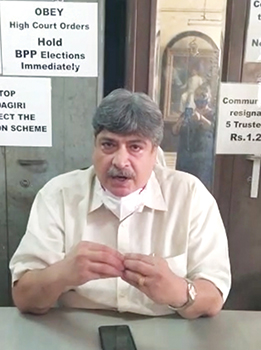
Dadrawala: mooting good governance as BPP trustee
"Little private islands”
What holds back Parsi trusts from performing at their best? "I would think they function as little private islands and in an insular manner… They do not invest in good HR (human resources) or building their capacity for growth or excellence,” he stated.
"A good trustee must be purpose oriented, positive in attitude and progressive in mind,” he said, adding that they must have vision, enthusiasm and a high sense of moral obligation to the trust and fiduciary duties as a trustee. "One must have an open mind with the ability to learn as one goes along.”
Dadrawala said his perceptions are not restricted to trusts in Bombay. "It is the case all over in the country,” citing the example of NPOs in the education sphere, such as Akanksha and Teach for India that are constantly on the lookout for which best practices from other organizations they could adopt and adapt. "That is missing in Parsi trusts.” Many of our trusts are in a time warp, he said. "Their attitude is we have been around for a hundred years… But, hey, wake up… The world has changed… Organizations have developed rapidly.”
The CEO feels that community trusts do not harness the power of social media constructively. "How many of our premier trusts do we see active on social media?” Lastly, trusts and trustees should be able to "take a stand on issues — without fear or favor!”
Providing an overview of the regulatory environment in the country for NPOs, Dadrawala notes, "At the state level NPOs are regulated by the charity commissioner in case of trusts; by the registrar of societies in case of societies; or registrar of companies in case of not-for-profit companies.” Most would want to enjoy tax exemption and offer tax deductions, say under section 80G of the Income Tax Act to donors and for which the income tax department would be the regulator. Provisions relating to deduction of taxes would be applicable. If the entity wishes to receive foreign contributions, it would require registration under FCRA and be regulated by the Ministry of Home Affairs (FCRA Wing).
"Besides, virtually all labor and human relations laws are applicable,” he said. For instance, an entity cannot say it is charitable and therefore it will not provide employee provident fund if it has more than 20 employees or gratuity to those who provide at least five continuous years of service.
"If the NPO supplies services in excess of Rs 20 lakhs or goods in excess of Rs 40 lakhs, it must register under Goods and Services (GST) Tax.” Dadrawala stated that any income from sale of goods and services must be in furtherance of the objects of the NPO. In case of NPOs whose objective is in the nature of general public good, the business income should not be more than 20% of its total income during the financial year.
"If the income exceeds expenditure, the same cannot be distributed by way of dividend to shareholders (in a Section 8 company) or members (in case of a society). "Such excess must be ploughed back into the NPO for furthering its charitable objects… that is the essence of an NPO.
"NPOs are not against national interest,” he emphasized. "We uphold national interest as no other sector does… Non-profit does not mean loss-making…We contribute, not just take.”