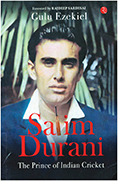
Salim Durani: The Prince of Indian Cricket by Gulu Ezekiel. Published in 2024 by Rupa Publications Pvt Ltd, 7/16, Ansari Rd, Daryaganj, New Delhi 110002. Pp: xviii + 181. Price: Rs 395.
Salim Durani was an extraordinarily gifted cricketer and a great crowd-pleaser with film star good looks. Gulu Ezekiel is a prolific, hugely knowledgeable writer on sports (particularly cricket) and is a bibliophile’s great friend. When the two come together in a book it is bound to be entertaining, well-researched and an important contribution to the growing literature on the game. That quite aptly sums up Ezekiel’s latest offering, Salim Durani: The Prince of Indian Cricket.

That the book is extremely well-researched is evident from the never-hitherto-told stories about Durani, particularly the details of his League exploits in England and about his father, Abdul Aziz who in 1947 suddenly upped and left for Karachi leaving behind his wife and children, including Salim, in Nawanagar (now Jamnagar). The author is unable to fathom the reasons that impelled Aziz to do so. He later became a well-known coach in Karachi, popularly called "Master Aziz,” and had a big role to play in the emergence of Hanif Mohammed as the original sub-continental "Little Master.”
Salim, born to a cricket-crazy father, inevitably made the cricket field his second home from an early age. His father was a reasonably successful wicketkeeper-batsman in the 1930s. He first turned out for Sind (Karachi) and made his mark at the famed Roshanara Club, playing the Delhi Tournament alongside the likes of Minocher Mobed (who later represented the Parsees in the Pentangular).
In 1935, Jam Saheb Digvijaysinhji, the great Ranjitsinhji’s successor, brought Aziz from Karachi to Nawanagar. Aziz played against the visiting 1936 Australian team led by Jack Ryder and later for Nawanagar in the Ranji Trophy where his teammates included Nariman Marshall, one of four Parsees who were part of the Indian team that toured England in 1932 for the inaugural Test match at Lord’s, though he did not play a single Test.
The book recounts how Marshall, the "fiery-tempered Parsi,” later became coach of the Rajasthan Ranji team for many years in the 1960s when Salim was an indispensable cog in that team.
Salim Durani (l) with Farokh Engineer; top: Gulu Ezekiel
In Nawanagar, little Salim, bereft of his father’s guidance, nevertheless made good in school level cricket, that is till he dropped out of school. He came under the influence of the great Vinoo Mankad and became a member of the Mankad household for many years, eventually playing for Mankad’s adopted team Rajasthan in the Ranji Trophy and Zonal Championships.
The biographer seeks to put a lid on the controversy surrounding Salim’s place of birth. Many authoritative books say it was in Kabul, Afghanistan. No, says the author, it was, in Salim’s own words, "in some corner of the Khyber Pass under the open sky…. in a caravan camp whilst my mother and her younger brother were on their way from Kabul to Karachi.” Reminiscent of Nari Contractor being born at Godhra in Gujarat when his mother Piroja developed labor pains while en route from Dahod to Bombay for the "delivery.”
The most interesting parts of the book are how Durani was handled by various captains he played under. Salim had his best performances under the captaincy of Contractor against the 1961 visiting MCC (Marylebone Cricket Club) team (the name under which the English cricket team toured abroad in those days). He made outstanding contributions as an all-rounder, resulting in India recording its first-ever series win against a visiting side with victories in the Tests at Calcutta and Madras. In the Calcutta Test of that series Polly Umrigar took over captaincy duties for a while on the crucial last day when Contractor had to leave the field. He too gave Durani full rein to display his skills as a bowler.
The two Parsi captains handled the effervescent Salim very well — an aspect which this reviewer thinks deserved to be more fully explored by the author. Maybe the two Parsi captains, accustomed as they were to the eccentricities and temperamental nuances of many members of their community, understood the genius of Salim best!
After the high of those successes, life took a different turn for Salim when, in the mid-1960s, he found himself in the wilderness for about four or five years, discarded from the Indian Test team once the Nawab of Pataudi took over the captaincy and the Spin Quartet of Bhishen Singh Bedi, Erapalli Prasanna, Bhagwat Chandrasekhar and Srinivas Venkataraghavan arrived on the scene.
Ezekiel focuses on skipper Pataudi’s admitted inability to "handle” Durani. Pataudi was not the sort to cajole senior players into performing well; he believed they should be disciplined enough to do that themselves. He thought Durani was an "underachiever,” given his great talents. The end result is confusing: on the one hand, Amrit Mathur, seasoned writer, averring that Tiger Pataudi told him that if he had to select an Indian team Salim Durani would be the first name he would put down; on the other hand, Pataudi’s conversations with the respected Rajan Bala, in which he accepted that he had differences with Salim and didn’t handle the temperamental genius well, preferring the more sedate Bapu Nadkarni as the first choice left-handed all-rounder.
The author attempts to bust the myth that Salim was temperamental and undisciplined and puts a quietus to the subject by quoting the great Sunil Gavaskar who said it was entirely incorrect to think that Salim was "moody” and a "wayward genius.” Genius he was, not a wayward one. The words of one of India’s greatest batsmen must settle the debate in Salim’s favor.
The author also gives a fascinating account of the fortuitous circumstances that led to Salim’s comeback into the Test team in 1971, when Ajit Wadekar replaced the Nawab as captain for the tour of the West Indies — and his stupendous dismissals of Gary Sobers and Clive Lloyd at the Queen’s Park Oval in the Port of Spain Test of that 1971 series with two "dream balls” — leading to India’s first-ever win against the mighty West Indies on their home ground.
Ezekiel has succeeded in getting into the character of his biographical subject and his persona, but there are passages in the book when this aspect is subordinated to an overdose of statistics. Statistical data is inevitable in the biography of any cricketer, nay, any sportsman, but in parts one senses a preponderance of figures where an analysis of the persons and tactics involved in the particular match may have better served the narrative. The photographs are not of the highest quality. No doubt they are reproductions from old publications or old photos, but with modern technology a way must be found to tone them up in later editions.
But these are minor cavils, for this book is a must read for anyone interested in Indian cricket and its history. There are never-before-told tales of Durani’s English League experiences as also of the machinations that went on before India’s first Test team toured England in 1932, and extremely readable accounts of the behind-the-scenes manipulations by the late Datta Ray, a formidable sports administrator who, the author contends, was responsible for keeping Durani out of the Test team for non-cricketing reasons.
This reviewer knew Salim well. We shared the Doordarshan commentary box for some years. Salim was a regular at the Khar Gymkhana when in Bombay. He was popular wherever he went. The author calls him "Destiny’s Child.” He was a simple, good soul, of charitable disposition, though for the better part of his life he didn’t have much for himself. As news anchor Rajdeep Sardesai says in his Foreword, "There was kindness in his heart and innocence in his soul.” He always had a child-like enthusiasm and passion for all things cricketing. He was not a "wasted talent” as some described him. He was a genius, plain and simple, the true prince of Indian cricket. And the book does full justice to the genius.
FREDUN E. DEVITRE
Devitre has been associated with cricket in India for almost 50 years as a commentator and freelance writer.