Earth. Poems for Veronik by Adil Jussawalla. Published in 2023 by Paperwall Publishing, A/103 – Krishna Residences, 379, Cardinal Gracious Rd, Chakala, Andheri (E), 400099, email: info@paperwall.in; website: www.paperwall.in Pp: vii + 11. Price: Rs 100, $ 6, € 5, £ 4.
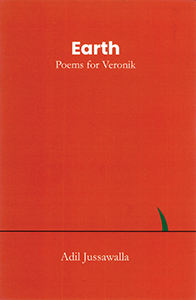
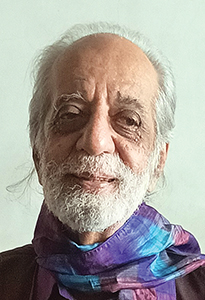 The cover has a rich patina of burnt caramel. A blade of green thrusts its thin dagger from a horizontal line at the lower end. The poet’s name, like that of a Samurai, lies under the surface as though threatening to spring into action. Those who are familiar with the name Adil Jussawalla (pictured) know that he makes his moves like that of a dancer in a ritualistic Japanese Kabuki performance: stealthily, but exactly, creating patterns on the page with words that are often tense with intangible effects.
You can decipher them or not, depending on how you view them.
The deep terracotta orange might be meant to reflect the title of the very slender collection of poems entitled Earth in white. The subtitle adds Poems for Veronik. A note at the back explains that Veronik (1934-2020) was a French citizen who met the poet in London in 1967. Veronik came to Bombay with her daughter Katia when Jussawalla decided to leave London. She and Jussawalla got married in 1971.
The note goes on to add: "These poems, among several written over many years, deal with the gardens Veronik and I knew and what the earth of these gardens brought us; its secrets, its meanings, its gifts. Sometimes it showed us the stars.”
It is in a sense quite the opposite of what one might expect of a poet writing about the loss of a partner, beloved or otherwise. It’s in part a botanical resume of their life together.
Here for instance is Milan Kundera, the recently deceased Czech writer, with his unbearable lightness with words, talking about poetry. "The purpose of poetry is not to dazzle us with astonishing thought, but to make one moment of existence unforgettable and worthy of unbearable nostalgia.”
Jussawalla’s poems, minimalist in tone and intent, live up to the first criterion. They do light a particular moment in time as imprinted in the poet’s life with Veronik. They do not however suggest that it’s for the sake of luxuriating in nostalgia, in the manner of a pollen dusted bee falling into the neck of a flower in search of nectar. And yet, for all his restraint, Jussawalla includes a line in French from the poet Guillaume Apollinaire at the beginning that translates more prosaically into English, "It’s high time we relit the stars.”
Do we hear echoes of T. S. Eliot’s The Waste Land? "Hurry up please, it’s time.”
In many of his poems Jussawalla has most often been an auditor of the arid plains that have made up the cityscape of his imagination. Yet here, he shows himself to be a star-gazer of rare charm.
The poem Amaryllis, a flower that is called belladonna in some parts of the world and star gazers in others, with its loud trumpet shaped flowers, is compared at first to the noise and clamor of Bombay.
Or to quote: "Red loudspeakers, four,/ announce the end of the ambient sound-/ the clatters, the clangors, the cacophonalias/ that plague our city; they mean to calm.” Yet at the end, the poet declares that maybe, just maybe, the trumpets have been raised to announce "the likely arrival of angels.”
 In much the same way, with unexpected turns of phrase the poems speak of a love of flowers, or of the earth, or of a dog, it’s pink tongue and ears, listening, as the grass below thrusts itself out of the ground. Or as the poem is entitled: The Garden’s Earth Yawns that begins with the lines: "The garden’s earth yawns./ It has a pink tongue. It has ears.”
I might be forgiven for adding my own meeting with Veronik and her dog, a Maltese Terrier named Pipaluk at the Hanging Gardens a very long time ago. I was not only proficient in French, I too had a similar looking dog, a Sydney Silky. We became dog-walking friends, but nothing more. She was still very French, very down-to-earth and when she announced that she was married to a poet, I did not follow it up and ask his name.
It may have been a defensive action. Looking back on a series of interviews that were done for Parsiana entitled "The Parsi Quartet” in the mid-1970s, I was to record the following remarks: "‘This interview doesn’t make sense,’ said Jussawalla, distinguished editor-critic-writer, full time lecturer and occasional poet, over the telephone, explaining why he did not feel inclined to discuss his views about poetry. ‘What’s the use of discussing my poetry just because I am a Parsi. I don’t even consider myself a Parsi. In any case the fact that I may be purple or black has nothing to do with my poetry.’ It was perhaps as a result of this that Jussawalla was able, in a later telephone conversation, to put his objections in proper perspective. ‘I don’t like this idea of creating subdivisions within subdivisions. If you must have a discussion on poetry, it must be on some other basis that all the poets are Parsis. There is no use discussing poetry in a vacuum...’”
I cannot help but also quote two lines from the same article in Parsiana where in the collection of poems Land’s End published in 1962 he describes a dinner being served by Tamilian domestics: "Dark skins serving dishes to the sallow/ Sweat more night than grapes-blood has.” Do we add that today, it might be unlikely that a poet would label a whole tribe of persons from the South as being essentially purple-grape skinned.
It’s perhaps pedantic to repeat a passage from the same Parsiana feature. "There is a frequent use of alliteration and carefully crafted rhyme schemes, all time-honored devices that he uses with skill and wit. His best asset is perhaps the ease with which he gets into a poem and automatically sets its tone, which varies from poem to poem. In a Drinking Song for the Ladies for example, we get a rollicking, rambunctious tone, while Geneva with smug puritanical complacency boasts, ‘My fountain leaps a sixth of a mile in hope;/ And Peace a turbine humming in the deep;’ quite blind to the irony that her emblems should be a stuffed eagle and a clawing clockwork bear.”
What remains fascinating however is that even here there is a love of the earth and its bounty. He writes: "Single flame pods twin; twigs frill to flowers;/ Leaves unfurl through loam; a greenshape spreads.”
Gulmohur blooms again in his poem entitled Codes to Veronik, that she collects after a night of rain and hints of a "terrible quarrel” that has her picking up the broken pieces of petals and rearranging them in a vase.
And finally, looking at the reflection of a streetlight outside their building, reflected as Jussawalla makes us see it reflected in a puddle, he is star struck all over again.
He calls out: "Hold my hand, love, jump across.”
As we the readers stretch our hands to collect the words that he has scattered across the page in a flurry of petals recollected with a fierce tenderness that could be termed love. GEETA DOCTOR
Doctor, a longtime contributor to Parsiana, is a writer and critic.