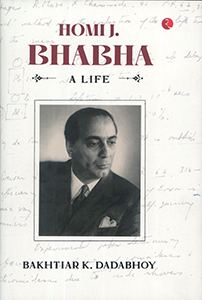
The internationally renowned scientist and father of India’s atomic energy program, Dr Homi Bhabha was "a notorious latecomer,” stated his biographer Bakhtiar Dadabhoy. But that did not prevent the book Homi Bhabha: A life being launched on time at the Homi Bhabha Auditorium on July 21, 2023 at the Tata Institute of Fundamental Research complex. The 776-page book published by Rupa and Company was released by R. Chidambaram, a former chairman of the Atomic Energy Commission and former principal secretary to the Government of India (GOI).
The tome contains 1,250 references, noted Dr Rajesh Vatsa, a scientist who heads the Public Awareness Division of the Atomic Energy Department. He commented that the 59-year-old author was "the highest and (possibly) the only Parsi in the Indian civil services.” Dadabhoy currently serves on the Railway Board in Delhi, the highest policy making body for the Indian Railways, the third largest railway network in the world after the USA and China. He has authored nine books, including an authorized biography of conductor Zubin Mehta (Zubin Mehta: A musical journey, Penguin 2017). Vatsa described Dadabhoy’s writing as "lucid. It makes me want to keep reading.” Referring to Bhabha, Vatsa reiterated the late Tata Group’s chairman J. R. D. Tata’s description of him as "truly a complete man.”
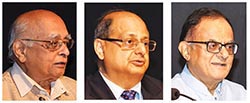
From l: R. Chidambaram, Bakhtiar Dadabhoy and Prof Ajay Sood
Dadabhoy became more acquainted with Bhabha when he wrote a chapter on him in his book, Sugar in Milk: Lives of Eminent Parsis. The book published by Rupa Publications in 2008 profiles 12 illustrious Parsis from Ardeshir Godrej to Field Marshal Sam Manekshaw.
Addressing the gathering of scientists and others, Dadabhoy modestly stated he did not "claim to have written anything new” about Bhabha but had placed "all the facts of the man in one place.
"Before I wrote that profile on Bhabha, my knowledge of him was limited to the fact that he was a distinguished physicist who pioneered fundamental research and atomic energy in India. At the time, I was only dimly aware of what a fascinatingly diverse man he was: a lover of music, an accomplished painter (and, later, an avid art collector), a violinist and a budding poet and much else. I also did not know much about Bhabha, the man — his loves, his likes, his bond with his parents, his close relationship with a lady and more.
"Learning all this, I was surprised to discover that no full-length biography of him had been written until then, one that would attempt to do justice to his important role in Indian science, and to the depth and diversity of his intellectual interests. There have been a few books on him, all with undeniable merit, but none that qualify as a full-fledged biography. I decided to supply this deficiency, though I hope that my non-existent scientific credentials have not made it a classic case of overreach...
"As a career bureaucrat for the last 35 years, the relevance of what Bhabha had to say with regard to administrative culture made an immediate and strong impression on me. He was very clear that he would not allow the convoluted, inflexible and dilatory processes associated with a bureaucracy to find a place in his institute. He was highly critical of the system where a file used to be marked to a number of persons who merely signed it without making any contribution whatsoever. Bhabha observed that the secretariat system of noting by half-educated clerks was one of the worst features of government and should not be introduced in the institute. He wanted precise notes, passing through fewer levels so that decisions could be taken faster. He also abolished the system of peons sitting on stools outside the offices and carrying files from one table to the other.
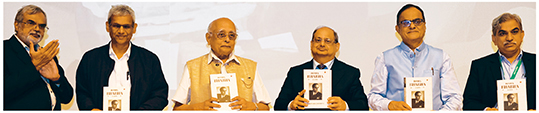
From l: At the book launch, Dr Mayank Vahia, Dr Rajesh Vatsa,
Chidambaram, Dadabhoy, Sood and J. Chengalur
"It was my intention to portray both Bhabha, the scientist, and Bhabha the person… Bhabha was a man who was aware of his special talents as most gifted people generally are. Certainly, he was very conscious of his own importance. He has often been accused of being haughty and arrogant and perhaps there is some truth in that assertion, but I believe it was only with people who he thought needed putting in their place. ‘He loved making the White man wait’ was a statement made by a foreign scientist. Unfortunately, as we know, Bhabha was notoriously unpunctual and made everyone wait...
"Bhabha was very kind and considerate to the people he worked with. There are numerous stories of his helping people, assistance which, I believe, was given without condescension. However, I think that he considered himself a cut above and hence could never develop any particularly warm or close relationships with colleagues or juniors... As a foreign academic put it, ‘Homi was a distant Alp. One did not presume to climb it.’ Bhabha did not take kindly to opposition and was not above subduing competition. But as British physicist Sir John Cockcroft pointed out, without a certain ruthless arrogance he would never have achieved what he did, and he did much.
"Before I conclude, I would like to leave you with a few questions over which to ponder. Did Bhabha do the right thing by centralizing research in one institute, ignoring the universities? Would we have had something on the lines of the proposed National Research Foundation much earlier had he lived longer? How different would India’s nuclear program have been if he had lived another 20 years?”
Under Bhabha India launched the atomic energy movement at a time when the country was not even manufacturing bicycles, which had to be imported, noted Chidambaram. He described Bhabha as a "renaissance man,” and a "unique blend of a yogi and a commissar.” He noted how, when the atomic scientist, "a stickler for cleanliness,” had visited a laboratory, he ran his fingers over a shelf to see if there was any dirt accumulated (there wasn’t). Bhabha also wryly commented when he saw an air conditioner on in a room with a window open: "You want to air condition the room as well as all of Bombay?” While some build institutions that wither and die after them, the systems that Bhabha introduced "continue to flourish after his death….he was a great institution builder.” Before starting any institution or department, he "first selected a leader and then built the group around” that person. On the subject of power supply he had famously said, "No power is as costly as no power.”
Prof Ajay Sood, principal scientific advisor to the GOI delivered the J. R. D. Tata Memorial Lecture. He titled the talk, "A Personal Scientific Journey Covering (the) Best of Both Worlds: From Vigyan to Vigyan Bhawan,” (from science to science administrator) but it ended up being a 90-minute-long, dry lecture on quantum physics followed by questions and answers.